

It’s one of the most frustrating experiences in the aquarium hobby: you notice your Mystery Snails, Nerite Snails, or Ramshorn snails developing pitted, chalky, or thinning shells. You immediately do what every forum and video recommends - you drop in cuttlebone, feed high-calcium blanched veggies, or add mineral blocks.
Yet, months later, the shell decay only gets worse. Holes appear near the apex, and the shell turns dangerously brittle.
What went wrong?
The answer lies in basic inorganic chemistry. Dietary calcium and water column calcium are useless if the surrounding water is acidic. No amount of calcium supplements can counteract the physical erosion caused by soft, low-pH water.
Here is the exact chemistry behind aquatic snail shell dissolution and how to actually protect your invertebrates.
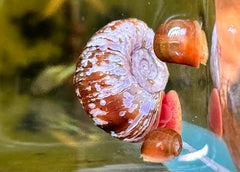
The Anatomy of a Snail Shell: Living Shield vs. Extracellular Matrix
To understand why pH ruins shells, you first need to understand how a gastropod builds its home.
A snail's shell isn't just a chunk of rock; it's a multi-layered composite bio-structure secreted by an organ called the mantle:
-
The Periostracum (Outer Layer): A thin, organic coating made of proteins (conchiolin). It gives the shell its color and acts as the initial protective barrier against chemical corrosion.
-
The Prismatic & Nacreous Layers (Inner Layers): Below the periostracum lies the bulk of the shell, composed primarily of calcium carbonate crystallized in aragonite or calcite matrices.
The vital distinction to understand is that a snail only secretes new shell material along the growing edge (the aperture). The older parts of the shell—like the apex and body whorls—are completely dead tissue. Once damaged from the outside, the snail cannot repair the exterior surface. It can only secret new layers internally to patch up holes before its soft body is exposed.
The Chemistry: How Acidic Water Dissolves
Why does low pH attack the shell regardless of how much calcium is in the snail's diet or water? It comes down to acid-base equilibrium.
Aquarium water with a low pH has a high concentration of free hydrogen ions. Calcium carbonate is inherently basic and soluble in acid. When acidic water contacts the exposed mineral layers of a snail's shell, a chemical reaction occurs. The acid actively strips the solid calcium carbonate out of the shell, dissolving it into liquid calcium ions and bicarbonate.
 [ Acidic Water (pH < 7.0) ]
        |
        |  High Concentration of Free H+ Ions
        v
 [ Shell Surface (Solid CaCO3) ]
        |
        |  Chemical Reaction: H+ attacks CaCO3
        v
 [ Dissolved Ca2+ Ions + Bicarbonate ]
        |
        v
 [ Result: Pitting, Thinning, & Holes ]
The Role of Carbonate Hardness (KH) vs. General Hardness (GH)
Many aquarists confuse GH and KH, leading directly to shell erosion:
-
GH (General Hardness): Measures dissolved Calcium and Magnesium ions.
-
KH (Carbonate Hardness): Measures dissolved Carbonate and Bicarbonate ions—the buffer that keeps your pH stable.
If you have a high GH (plenty of calcium) but low KH (low buffering capacity) and low pH, the water is still acidic. Even if the water is saturated with calcium, the high concentration of H+ ions will continue to dissolve the solid calcium carbonate in the snail's shell.
Key Takeaway: Adding calcium increases GH, but it does not stop acidic water from chemically eating away at the shell. You must stabilize the pH and KH.
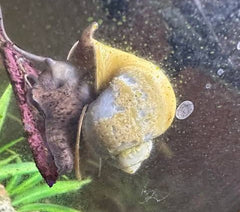
Why Dietary Calcium Can't Fix External Erosion
A common myth is that feeding calcium-rich foods like "Wonder Shells," "Snello," or spinach will repair an eroding shell.
Here's why that logic fails:
-
Dietary Calcium builds new shell growth at the mantle edge (aperture).
-
Water pH attacks existing shell exterior everywhere else.
When a snail ingests calcium, its body absorbs the nutrients to build new growth going forward. However, ingested calcium travels through the digestive tract and mantle—it cannot travel outside the body to coat or repair the old whorls on the exterior of the shell.
If your pH is 6.5, your snail might grow thick, healthy new shell at the rim thanks to a great diet, while the apex of its shell is simultaneously dissolving into the water.
Ideal Water Parameters for Freshwater Snails
To prevent shell dissolution completely, you must maintain water parameters that favor calcium deposition rather than dissolution:
-
pH (Ideal Range: 7.5 – 8.2): Prevents free H+ ions from reacting with CaCO3. Water below 7.0 will slowly dissolve shells over time.
-
KH (Ideal Range: 4 – 8 dKH): Buffers the water, preventing dangerous pH swings and providing vital carbonate ions to maintain equilibrium.
-
GH (Ideal Range: 8 – 12 dGH): Ensures sufficient dissolved mineral levels so the water doesn't leach minerals directly from the snail's mantle.
-
Temperature (Ideal Range: 72°F – 78°F / 22°C – 25°C): High temperatures accelerate metabolism and growth, often leading to thinner, weaker shells if parameters aren't kept perfect.
Step-by-Step Fix: How to Stop Shell Erosion in Soft Water
If your tank currently has soft, acidic water, throwing in a cuttlebone isn't enough. Follow these steps to fix your water chemistry safely:
-
Raise Your Carbonate Hardness (KH) & pH Naturally:
-
Add Crushed Coral or Aragonite to your filter media inside a mesh bag. As water flows through, it slowly dissolves carbonate into the water column, safely raising both pH and KH without sudden spikes.
-
Target a pH of at least 7.4 to 7.6.
-
-
Seal Extremely Severe Shell Damage:
-
If a snail has an actual hole exposing its mantle tissue, the internal environment is compromised.
-
You can carefully dry the shell surface and apply a tiny patch using odorless cyanoacrylate super glue combined with a piece of sterile eggshell membrane or sanitized cuttlebone piece. (Note: Do not get glue on the snail's body or mantle lip!)
-
-
Provide Dual-Action Calcium Support:
-
In the Water: Keep GH around 8–10 dGH using a complete mineral re-mineralizer (like Seachem Equilibrium or SaltyShrimp GH/KH+).
-
In the Diet: Feed calcium-dense foods (blanched zucchini, kale, high-quality invertebrate pellets) so new growth remains dense and resilient.
-
High calcium feeds growth, but pH dictates survival. If your water is acidic, chemistry will win every time, slowly dissolving your snail's shell regardless of their diet. By shifting your focus from just adding calcium to buffering pH and KH, you create an environment where your aquatic invertebrates can thrive with pristine, thick shells.
Freshwater Aquarium Care Guides
Shop related: All Mystery Snails, Water Care, Substrate, Hardscape, Algae Wafers, Live Plants.
Other blogs: Nerite vs Mystery Snail: Best choice for your aquarium, Why snails are essential for a self-sustained ecosystem, What makes mystery snails ideal for beginner tanks.