

Aquascaping is the art of arranging aquatic plants, aquarium rocks, driftwood, and aquarium substrate within an aquarium to create a visually striking underwater landscape. Far more than just keeping fish in a tank, aquascaping combines artistic design principles with living ecosystems.
Over the decades, distinct aquascaping styles have evolved, each with its own philosophical origin, structural rules, and maintenance demands. Whether you prefer dense, colorful botanical gardens or minimal, meditative rock formations, understanding these styles is the best way to choose the right layout for your home aquarium.
1. The Dutch Style: The Underwater Botanical Garden
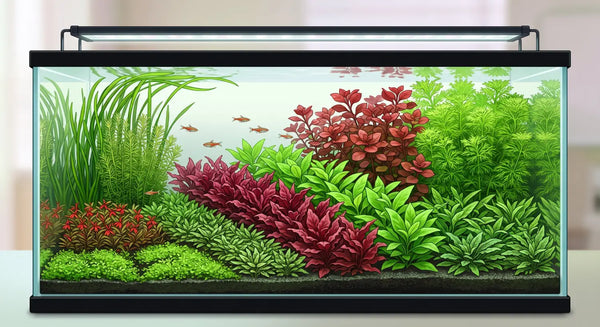
Originating in the Netherlands in the 1930s, the Dutch Style is the oldest and most structured form of modern aquascaping. Popularized by the NBAT (Dutch Society for Aquariology), this style focuses almost entirely on lush, contrasting plant growth rather than hardscape materials like rocks or wood.
       [ Dutch Aquascape Layout ]
+----------------------------------------+
| [Background Plants - High/Textured]   |
|   (Limnophila / Vallisneria / Stem)    |
|                                        |
| [Midground Plants - Contrasting Color] |
|   (Ludwigia / Alternanthera / Crypts)  |
|                                        |
| [Dutch Street] --> ~~~~  (Low Staurogyne)|
|                                        |
| [Foreground Carpeting / Low Plants]    |
|   (Lobelia / Cryptocoryne parva)       |
+----------------------------------------+
Key Principles & Layout Rules
-
No Hardscape: Rocks and driftwood are strictly minimized or omitted entirely. Plants drive 100% of the visual interest.
-
Plant Diversity Limit: A common guideline is to use no more than one plant species per 10 centimeters (4 inches) of tank length to prevent visual clutter.
-
The "Dutch Street" Technique: Plants are arranged in sloping rows from front to back at an angle, creating depth and leading the viewer's eye into the aquascape.
-
Color and Texture Contrast: Success depends on placing plants with opposing leaf shapes, sizes, and colors (e.g., fine-leaved bright green plants next to broad-leaved deep red species) side by side.
-
Golden Ratio & Focal Points: Key focal plants are positioned precisely using the Rule of Thirds.
Common Plant & Flora Choices
-
Foreground: Lobelia cardinalis, Staurogyne repens, Cryptocoryne parva
-
Midground/Dutch Streets: Alternanthera reineckii, Hygrophila corymbosa, Bacopa caroliniana
-
Background: Limnophila Hippuridoides, Rotala macrandra, Vallisneria
| Dutch Style Overview | |
| Difficulty Level | High |
| Co2 Requirement | Pressurized CO2 strongly recommended |
| Lighting Needs | High |
| Trimming Frequency | Weekly to bi-weekly |
2. The Nature Aquarium Style: Bringing Wild Landscapes Indoors
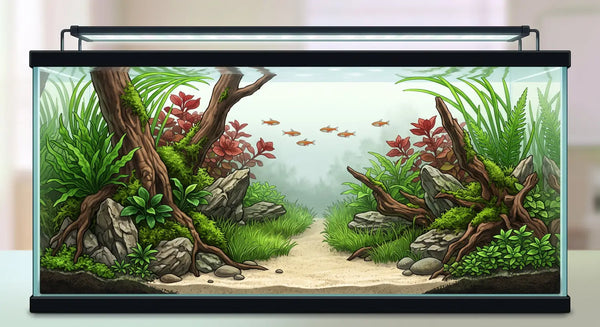
Pioneered in the 1990s by Japanese photographer and aquarist Takashi Amano, the Nature Aquarium Style revolutionized aquascaping. Inspired by Japanese gardening concepts (such as Wabi-sabi), this style aims to recreate natural terrestrial landscapes—such as rainforests, mountain valleys, or riverbanks—inside an aquarium.
Key Principles & Layout Rules
-
Asymmetrical Balance: Avoid strict symmetry. Layouts typically follow one of three primary structures:
-
U-Shape: High growth on the left and right sides, leaving a lower open space in the middle to create depth.
-
Triangle: High hardscape/plants on one side, sloping down to an open space on the opposite side.
-
Convex (Island): High center with open space on both sides.
-
-
Hardscape Integration: Rocks (Maten, Seiryu) and driftwood (Bogwood, Manzanita) form the structural backbone. Plants grow around and over the hardscape to mimic nature's reclaiming process.
-
Negative Space: Open water and visible substrate are essential elements, giving the landscape breathing room and scale.
Sub-Types of Nature Style
-
Ryoboku: Driftwood-dominant layouts paired with mosses and epiphytes.
-
Iwagumi: Rock-dominant layouts (often classified separately due to its strict rules).
Common Plant & Hardscape Choices
-
Plants: Eleocharis acicularis (Dwarf Hairgrass), Glossostigma elatinoides, Microsorum pteropus (Java Fern), Anubias nana petite, Christmas Moss.
-
Hardscape: Spiderwood, Manzanita Driftwood, Seiryu Stone, Okho Dragon Stone.
| Nature Style Overview | |
| Difficulty Level | Moderate to High |
| Co2 Requirement | Medium to High |
| Lighting Needs | Moderate to High |
| Trimming Frequency | Every 2–3 weeks |
3. The Iwagumi Style: Minimalist Rock Formations
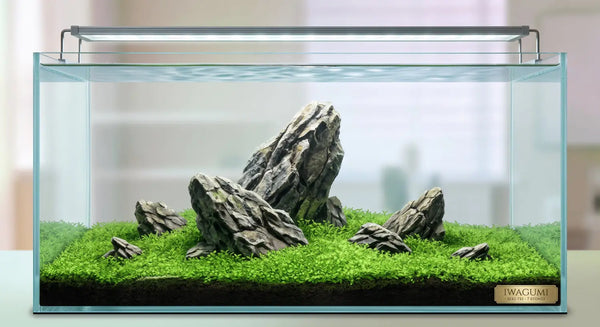
Iwagumi (Japanese for "Rock Formation") is technically a subset of the Nature Aquarium style, but its rigid guidelines and distinct philosophy make it a standalone style. Rooted in Japanese rock gardening (Seki-tei), Iwagumi aquascapes embody minimalism, tranquility, and precise composition.
            [ Iwagumi Rock Structure ]

                       O  (Oyaishi - Master Stone)
                      / \
                     /   \
  (Fukuishi)  o     /     \
   Secondary /     /       \   o  (Soeishi)
            /     /         \ /
           o-----o-----------o---.  o  (Suteishi - Hidden)
  ============================================== [Carpet Layer]
The Standard Rock Layout Rules
An Iwagumi layout traditionally uses an odd number of rocks (3, 5, 7, etc.) to prevent unnatural symmetry, each fulfilling a specific structural role:
-
Oyaishi (Master Stone): The largest, most striking rock. Placed off-center according to the Golden Ratio, it dictates the direction and flow of the entire aquascape.
-
Fukuishi (Secondary Stone): The second-largest rock, placed near the Oyaishi to balance its visual mass and match its angle.
-
Soeishi (Companion Stone): Smaller rocks placed to support and emphasize the primary stones.
-
Suteishi (Hidden Stone): Tiny, sacrificial stones often eventually covered by carpeting plants, added to smooth transitions and build subtle texture.
Plant Selection & Livestock
Plant choice in Iwagumi is strictly limited to low-growing foreground carpeting plants so as not to obscure the rock structure.
-
Carpeting Plants: Monte Carlo (Micranthemum tweediei), Hemianthus callitrichoides (HC Cuba), Dwarf Hairgrass.
-
Livestock: A single large school of small, peaceful schooling fish (such as Cardinal Tetras, Harlequin Rasboras, or Rummy-nose Tetras) to maintain focus on the rock formation.
| Iwagumi Style Overview | |
| Difficulty Level | High (Highly susceptible to algae due to low plant mass) |
| Co2 Requirement | High (Crucial for dense carpeting plants) |
| Lighting Needs | High |
| Trimming Frequency | Low (Mostly carpet maintenance) |
4. The Biotope Style: Recreating Wild Ecosystems
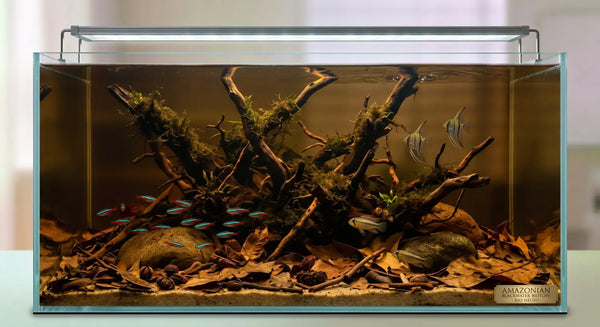
Unlike Dutch, Nature, or Iwagumi styles—which prioritize human visual aesthetics—the Biotope Style prioritizes biological accuracy. A true biotope aquascape replicates a specific natural water body in the wild down to the exact flora, fauna, water chemistry, and hardscape components found in that exact location.
Key Principles & Layout Rules
-
100% Geographic Accuracy: All organisms (fish, plants, invertebrates) and materials (substrate type, wood, stone) must naturally coexist in the chosen habitat (e.g., a specific blackwater stream in the Rio Negro, Amazon Basin).
-
Embracing Imperfection: Leaves, fallen seed pods, tannins, and irregular wood arrangements are encouraged to mirror natural riverbeds or lakesides.
-
Environmental Parameters: Water parameters (pH, GH, KH, temperature, light intensity) are dialed in specifically to match the natural habitat.
Common Biotope Types
-
Amazonian Blackwater: Dark, tannin-stained water with leaf litter, fallen branches, gentle flow, and species like Angelfish or Apistogramma.
-
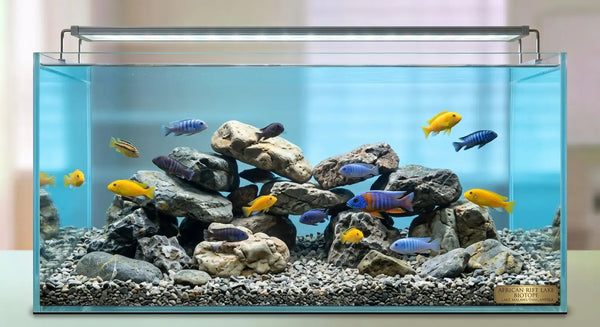
African Rift Lake (Lake Malawi/Tanganyika): High pH/alkaline water, rocky substrate, zero plants, and colorful cichlids.
-
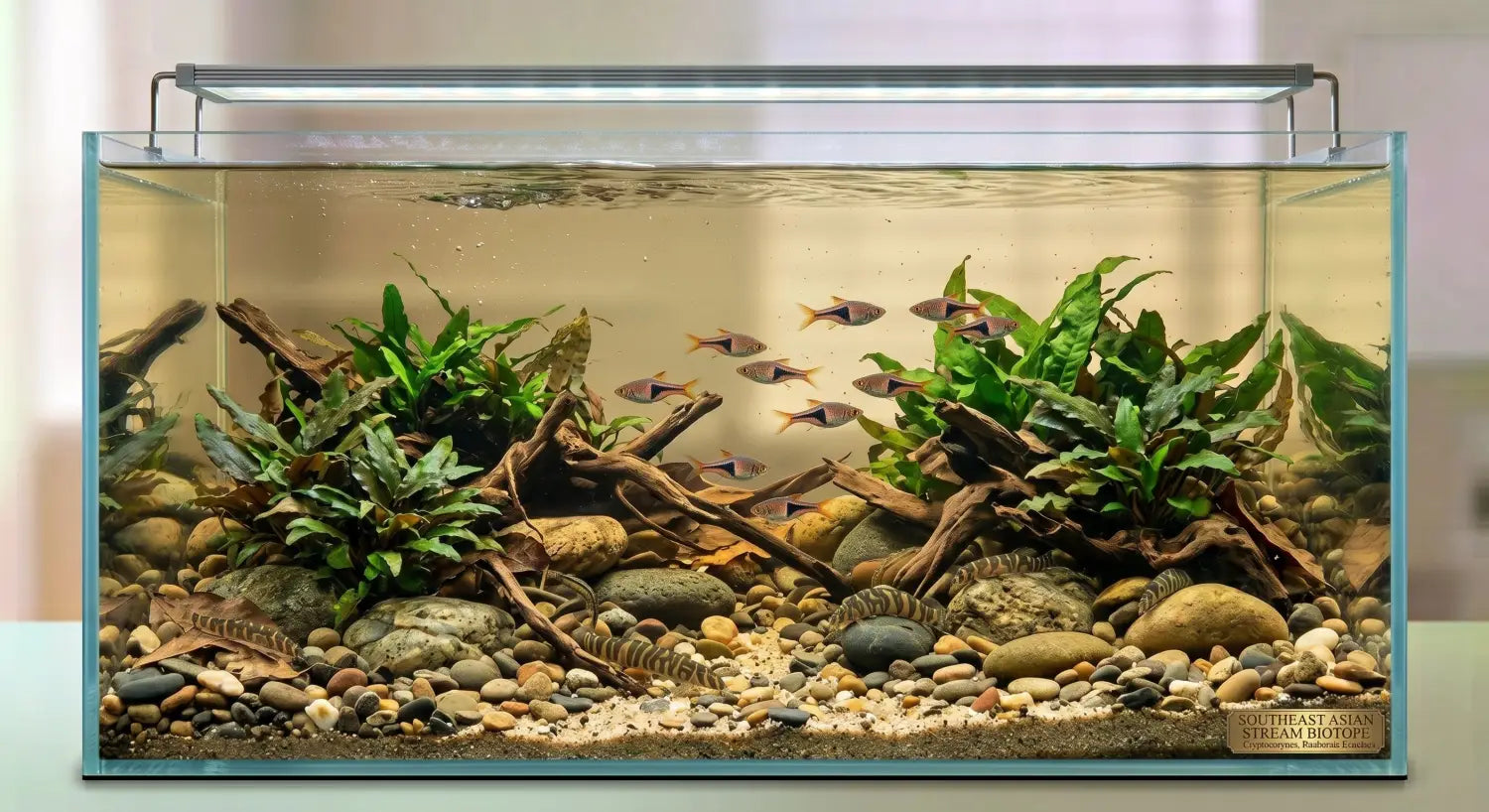
Southeast Asian Stream: Pebble substrate, moderate flow, cryptocorynes, and loaches or rasboras.
| Biotope Style Overview | |
| Difficulty Level | Low to Moderate (Requires research rather than intense pruning) |
| Co2 Requirement | Usually None |
| Lighting Needs | Low to Moderate (Often low-light or open environments) |
| Trimming Frequency | Low |
Comparing Aquascaping Styles
| Feature | Dutch Style | Nature Style | Iwagumi Style | Biotope Style |
| Primary Focus | Plant color & arrangement | Terrestrial nature landscape | Rock geometry & symmetry | Ecological accuracy |
| Hardscape Use | Minimal / None | High (Wood & Stone) | Exclusive (Stone only) | Variable (Natural debris) |
| Plant Variety | High diversity | Moderate diversity | Extremely low (1–2 species) | Region-dependent |
| Maintenance | Frequent plant trimming | Moderate trimming & balance | Carpet trimming & algae control | Water chemistry testing |
Choosing the Right Style for You
When deciding which aquascaping style to pursue, consider your budget, available time, and experience level:
-
Choose Dutch if you love intense garden design, vibrant plant colors, and enjoy weekly trimming sessions.
-
Choose Nature if you want a balanced, artistic representation of trees, forests, or valleys using wood and rocks.
-
Choose Iwagumi if you appreciate minimalist, Zen-like aesthetics and are prepared to manage high light and CO2 for carpeting plants.
-
Choose Biotope if you are a fish-first hobbyist who loves natural animal behaviors, ecological research, and low-maintenance plant setups.
Freshwater Aquarium Care Guides
Shop related: Red Plants, All plants, WeekAqua Lighting, Fertilizers, Water Test Strips.
Other blogs: How many hours of light do aquarium plants really need, Why are my plants losing leaves, Choosing the best aquarium substrate, Increasing red coloration in aquarium plants.