

In the aquarium hobby, the amount of time your lights stay on over a 24-hour cycle is known as the photoperiod. Finding the perfect balance for your photoperiod is the ultimate secret to growing lush, vibrant underwater flora while keeping pesky algae entirely at bay.
If you are just starting out, utilizing a beginner planted tank guide can give you a solid baseline for balancing your lighting with nutrients and CO2. So, how many hours of light do aquarium plants actually need? Let's dive deep into the science of aquarium lighting, break down timelines for different tank setups, and help you dial in the perfect settings for your setup.
The Short Answer - The Golden Rule of Aquarium Lighting
If you are looking for a quick baseline to program your light timer today, here is the golden rule:
The vast majority of aquarium plants thrive with 6 to 8 hours of light per day.
7 to 8 hours of light; 16 to 17 hours of darkness
This 7-to-8-hour window provides aquatic plants with plenty of energy to complete daily photosynthesis without leaving the door open for an aggressive algae breakout. While land-based crops in agricultural settings can often tolerate or even thrive under extended photoperiods of 12 to 16+ hours, aquatic ecosystems are far more fragile.
In a closed aquarium, running your lights for 10, 12, or more hours will quickly exhaust the available nutrients and carbon dioxide (CO2) in the water column. Once your plants starve and halt their production, opportunistic algae step in to feast on the remaining light energy.
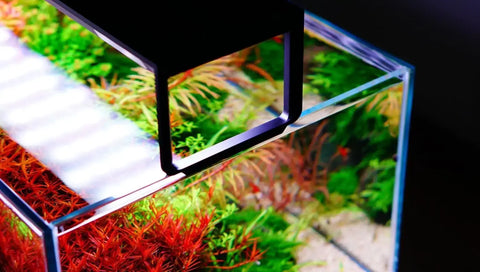
Match Your Photoperiod to Your Tank Type
Not every aquarium is built the same way. The perfect lighting schedule for your setup depends heavily on whether you are running a simple, low-maintenance tank or a high-tech, heavily fertilized aquascape.
Freshly Set Up Aquariums (0 to 6 Weeks)
When a tank is brand new, the entire ecosystem is highly unstable. Your plants are adjusting to a new environment, their root systems haven't fully established, and the beneficial bacteria cycle is still balancing out.
-
Recommended Duration: A strict 7 hours of light per day.
-
Why it matters: Giving plants an excess of light before they have the root systems to absorb nutrients is an open invitation for a massive diatom or green water outbreak. You can slowly scale the timer up by 30-minute increments every couple of weeks once you spot active, healthy new plant growth.
Low-Tech, Low-Light Aquariums
If you are growing hardy, beginner-friendly species—such as Anubias, Java Fern, Cryptocoryne, or Amazon Swords—without pressurized CO2 gas and with only minimal liquid fertilizer, you have a low-tech setup.
-
Recommended Duration: A steady 7 to 8 hours of light per day using low-intensity fixtures.
-
Why it matters: Because the light intensity in low-tech setups is relatively gentle, the plants need a slightly longer window of exposure to gather enough energy for photosynthesis. Since growth is slow, keeping the light intensity low prevents algae from taking advantage of the 8-hour duration.
High-Tech, High-Light Aquariums
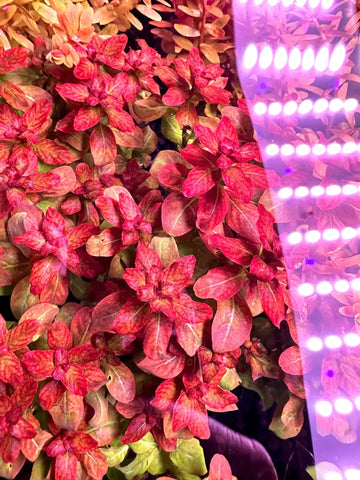
High-tech tanks feature demanding plants (like red stem plants or thick carpeting grasses) paired with bright, high-PAR LED fixtures, nutrient-rich aqua-soils, and pressurized CO2 injection systems.
-
Recommended Duration: A highly precise 8 hours of light per day.
-
Why it matters: High-tech tanks operate at maximum speed and photosynthesis is firing on all cylinders. If your high-intensity lights stay on even an hour too long after your plants have consumed the day's dialed-in dosage of CO2 and liquid nutrients, the tank's balance shatters, resulting in rapid algae blooms like Hair Algae or Black Beard Algae (BBA).
The Biology: Why Aquatic Plants Demands a Dark Period
It is a common misconception that keeping lights on longer means faster growth. In reality, plants don't just use light to grow; they actively require periods of complete darkness to stay healthy.
The biological life cycle of a plant operates in two distinct phases:
Phase 1: The Light-Dependent Reactions (Photosynthesis)
When the aquarium light turns on, the chlorophyll inside the plant leaves absorbs photons. The plant uses this energy to split water molecules and convert carbon dioxide into simple sugars (glucose), releasing oxygen as a byproduct. Think of this as the plant's "charging" and "cooking" phase.
Phase 2: The Light-Independent Reactions (Respiration)
When the light turns off, the plant switches to respiration. It takes those stored sugars and metabolizes them into complex structures—building new roots, pushing out fresh leaves, and repairing cellular tissue.
Without a dedicated, consistent dark period, the plant's internal biological clock experiences severe stress. Constant exposure to light can cause photoinhibition, where the delicate photosynthetic machinery becomes overloaded and damaged by light energy, stalling growth entirely.
Pro-Tips for Managing Your Aquarium Lighting
To set yourself up for ultimate aquascaping success, implement these three highly effective lighting management practices:
1. Buy a Digital Outlet Timer
Human memory is inconsistent. Turning your lights on manually at 8:00 AM on Monday, but sleeping in until 11:00 AM on Saturday, throws off your ecosystem. A cheap digital or smart-plug outlet timer ensures your tank gets the exact same photoperiod every single day, giving your plants a predictable rhythm.
2. Watch Out for Room Daylight
Your aquarium light isn't the only source of energy hitting your tank. If your aquarium is positioned across from a sunny window or in a room flooded with ambient daylight, that counts toward your total photoperiod. If your tank gets hit by direct afternoon sunlight, you may need to reduce your aquarium light timer to offset the ambient energy.
3. Try the "Siesta" Lighting Method
If you work a standard 9-to-5 job, a single 8-hour block of light means your tank turns on and off while you aren't even home to enjoy it. To fix this, many hobbyists use a split-schedule or "siesta" lighting method:
Plants adjust wonderfully to a split photoperiod, whereas primitive algae structures struggle to adapt to the sudden interruption in energy.
Diagnosing Lighting Issues: Reading Your Plants
Your plants will tell you exactly how they feel about your current light timer. Learn to recognize these critical warning signs:
Signs You Need MORE Light (Duration or Intensity)
-
Etiolation: Stem plants become incredibly leggy, showing long spaces of bare stem between sets of leaves as they desperately stretch upward toward the light source.
-
Loss of Color: Vibrant red or orange plants slowly fade into a dull, muddy green.
-
Lower Leaf Loss: The bottom leaves of your background plants turn yellow, decay, and fall off because the light can't penetrate through the upper canopy.
Signs You Need LESS Light (Your Photoperiod is Too Long)
-
Green Dust Algae: A stubborn film of fine green dust coats your aquarium glass within 48 hours of cleaning it.
-
Black Beard Algae (BBA): Tough, dark, tufted patches of furry algae start anchoring themselves onto your slow-growing plant leaves and hardscape elements.
-
Stunted Leaf Development: New plant leaves emerge twisted, unusually small, or tightly curled inward due to light-induced stress.
Achieving a gorgeous planted tank isn't about blasting your ecosystem with maximum light for as long as possible. It is entirely about balance. Start your aquarium at a modest 6 to 7 hours of daily light, watch how your plants respond over a few weeks, and slowly adjust your photoperiod until you hit that perfect, crystal-clear sweet spot.
Freshwater Aquarium Care Guide
Shop related: WeekAqua Lighting, All Aquarium Lighting, Aquatic Plants, Aquatic Plant Fertilizers, Aquarium Water Test Kit.
Other blogs: Why are my aquarium plants dying? Top 5 mistakes, Do red aquarium plants really need co2 and strong lighting, How many hours of light do aquarium plants need.