
If you’ve been scrolling through Instagram or Pinterest looking at breathtaking, lush underwater jungles, you’ve probably heard the terms “low-tech” and “high-tech” thrown around.
In the world of aquascaping, these two approaches represent entirely different philosophies, budgets, and daily routines. Choosing the wrong setup for your lifestyle is the number one reason beginners end up frustrated, staring at a tank full of melting plants and green algae. To set yourself up for success from day one, it helps to ground your journey with a reliable beginner planted tank guide before diving into the gear.
So, how do you decide which path to take?
In this ultimate guide, we will break down the differences between low-tech and high-tech planted tanks, analyzing costs, gear, maintenance, and plant choices. By the end, you will know exactly which setup fits your budget, space, and goals.
What is a Low-Tech Aquascape?
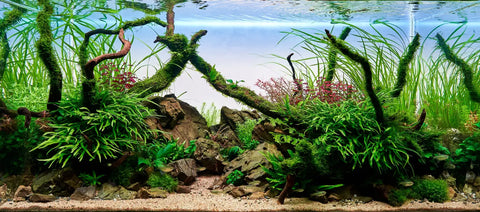
A low-tech tank is an aquarium that relies primarily on natural biological processes rather than advanced machinery. It is defined by one major factor: no injected carbon dioxide gas.
Low-tech tanks use moderate lighting and slower-growing plants. Because everything moves at a calmer pace, these tanks are incredibly forgiving and highly stable.
[Moderate Light] ──> [Slow Plant Growth] ──> [Low Nutrient Demand] ──> [Minimal Maintenance]
The Pros:
-
Budget-Friendly: You don’t need expensive regulators, gas cylinders, or high-end lighting fixtures.
-
Low Maintenance: Water changes are less frequent, and plants only need trimming every few weeks.
-
Forgiving Ecosystem: If you forget to dose fertilizer for a week, or if your light stays on an hour too long, a low-tech tank is hard to crash. Algae outbreaks are much easier to manage.
The Cons:
-
Slow Growth: It can take months for a low-tech tank to look completely mature.
-
Limited Plant Palette: You cannot grow demanding, bright red stem plants or thick, neon-green carpets (like Dwarf Baby Tears).
What is a High-Tech Aquascape?
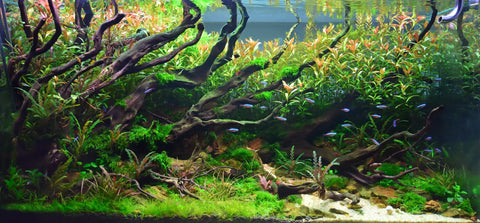
A high-tech tank is a fine-tuned, high-performance ecosystem. It is defined by the integration of pressurized CO2 injection, high-intensity lighting, and heavy nutrient dosing.
Think of a high-tech tank like a sports car. When everything is tuned perfectly, the results are mind-blowing: explosive growth, pearling (plants releasing visible oxygen bubbles), and vivid coloration. However, if one variable goes out of balance, things can go wrong very quickly.
The Pros:
-
Limitless Plant Options: You can grow any aquatic plant in the world, including difficult carpeting plants and deep, vibrant reds.
-
Rapid Maturity: A high-tech tank can achieve a fully grown, lush, competition-ready look in just 2 to 3 months.
-
The "Pearling" Effect: High light and CO2 cause plants to photosynthesize so rapidly that they stream pure oxygen bubbles—a mesmerizing sight.
The Cons:
-
High Initial Cost: Pressurized CO2 systems, high-PAR LED lights, and specialized aquasoils can easily run into hundreds of dollars.
-
Strict Maintenance Schedule: Plants grow so fast they require weekly trimming. Missing a single fertilizer dose or experiencing a CO2 fluctuation can trigger an immediate, aggressive algae bloom.
Key Differences at a Glance
To better understand how these two systems compare, let's look at the core components side-by-side:
-
CO2 Injection: Low-tech setups completely avoid it, relying on ambient air and livestock respiration. High-tech setups require a pressurized CO2 cylinder and regulator system.
-
Lighting Requirements: Low-tech tanks use low-to-moderate, simple LED lights. High-tech tanks require intense, high-PAR programmable RGB-UV lights to drive rapid photosynthesis.
-
Substrate Choices: Low-tech tanks can successfully use inert sand, gravel, or capped potting soil. High-tech setups almost exclusively require nutrient-dense, specialized aquasoils.
-
Growth and Trimming: Plants grow slow and steady in low-tech setups, requiring maintenance every 4 to 8 weeks. High-tech growth is up to ten times faster, requiring demanding trims every 7 to 14 days.
-
Algae Vulnerability: Low-tech changes happen gradually, making algae risks relatively low. High-tech systems require a precise chemical balance; even minor errors can spark an overnight algae explosion.
The Plant Profiles: What Can You Actually Grow?
Your plant wish list should heavily dictate which tank style you choose. Let's look at what thrives in each environment.
Best Low-Tech Plants
Low-tech plants are rugged, adapt well to low light, and feed efficiently from the water column or root tabs.
-
Anubias (All varieties): Virtually indestructible; must be attached to rocks or wood rather than buried.
-
Java Fern & Bolbitis: Great background and midground plants that require zero substrate.
-
Cryptocoryne (Crypts): Beautiful, moody root-feeders that come in bronze, green, and red hues.
-
Java Moss / Christmas Moss: Perfect for texturing hardscape and providing shrimp habitats.
-
Amazon Swords: Huge, dramatic background plants that thrive with simple root tabs.
Best High-Tech Plants
These plants require intense light to retain their color and massive amounts of CO2 to build their delicate cellular structures.
-
Hemianthus callitrichoides (Dwarf Baby Tears): The ultimate, lush, bright green foreground carpet.
-
Rotala Macrandra / Rotala H'Ra: Stem plants that explode into brilliant, fiery reds under intense light.
-
Ludwigia Pantanal: A breathtaking, highly demanding stem plant with neon pink and orange leaves.
-
Glossostigma elatinoides: A classic, fast-growing carpeting plant made famous by Takashi Amano.
The Verdict: Which One Is Right For You?
Choose a Low-Tech Tank if...
You want a beautiful, calming slice of nature in your home that doesn’t feel like a second job. You have a modest budget, you prefer a relaxed maintenance schedule, and you are content with classic, hardy green plants. It’s also the perfect option for office spaces or bedrooms where you want a stable, self-sufficient ecosystem.
Choose a High-Tech Tank if...
You are a passionate hobbyist who wants to treat aquascaping as a serious art form. You want to recreate the lush, rolling green hills and vibrant red forests seen in international aquascaping competitions. You have the budget to invest in quality gear and the time to dedicate to weekly trimming, testing, and water changes.
Can You Bridge the Gap? (The "Medium-Tech" Alternative)
If you are stuck in the middle, you aren't alone. Many modern aquascapers build "Medium-Tech" setups.
By using a nutrient-rich aquasoil and a high-quality light, but choosing not to inject commercial gas, you can grow a massive variety of intermediate plants. Alternatively, you can use a low-cost DIY citric acid or yeast CO2 system to give a low-tech tank a slight boost without breaking the bank.
No matter which path you choose, the golden rule of aquascaping remains the same: balance. Match your lighting strength to your nutrient and CO2 levels, and nature will handle the rest.
Freshwater Aquarium Care Guides
Shop related: Low-Tech Plants, High-Tech Plants, Fertilizers, Lighting, Red Plants, Aquascaping Tools.
Other Blogs: Stem Plant Propagation, Holes in Plants, Plants Loosing Leaves, Aerial Roots Guide.