

Among the most mesmerizing sights in the freshwater aquascaping hobby is a lush, vibrant burst of deep crimson, intense orange, or brilliant pink foliage cutting through the vivid green. Red aquarium plants like Ludwigia Super Red Mini, Alternanthera reineckii, and Rotala Magenta are highly sought after for this exact reason. However, a persistent debate dominates local fish stores and online forums alike: Do red aquarium plants really need injected CO2 and strong lighting?
The short answer is: No, not all of them strictly require both to survive, but achieving that jaw-dropping, fiery-red coloration and compact growth pattern is incredibly difficult—and often impossible for certain demanding species—without balancing high-intensity light and pressurized carbon dioxide.
To master these parameters and design a cohesive layout for your entire ecosystem from the start, check out our comprehensive planted aquarium care guide for expert tips on equipment selection and nutrient dosing.
To truly understand why red plants behave this way, we have to look past the myths and examine the exact biological and environmental triggers that control plant pigmentation under water.
The Science of Red: Anthocyanins, Light, and the Carbon Link
In green aquarium plants, chlorophyll is the dominant pigment, optimized for capturing light energy to drive photosynthesis. Red plants also utilize chlorophyll, but they produce high concentrations of accessory pigments called anthocyanins. Anthocyanins act as a biological sunscreen, shielding the plant’s delicate internal structures from excessive light stress.
When an aquatic plant is exposed to strong lighting, it produces more anthocyanins to safeguard its tissues, turning red, pink, or purple. However, this defensive process requires significant energy. If the plant cannot photosynthesize efficiently due to a lack of core raw materials, it will prioritize survival over pigment production. It will shed its red armor and revert to green to capture every photon possible.
In simple terms, aquatic photosynthesis follows a strict balance: Water + Light + Carbon Dioxide = Plant Growth. If you scale up the light factor to force the red color without scaling up available carbon dioxide, the plant hits a severe metabolic bottleneck. It cannot build sugars, growth stalls, and the red pigments fade or dissolve into algae outbreaks.
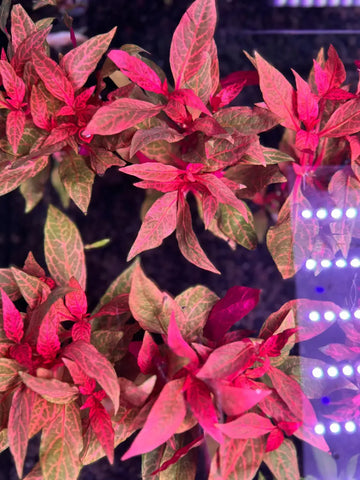
The "High-Light" Trap Without CO2
This is where the low-tech aquarist encounters a dangerous catch-22. To force a plant to produce red anthocyanins, you must provide strong lighting. But when you blast an aquarium with high-intensity light without introducing supplemental carbon dioxide, the plants consume the trace amounts of naturally occurring dissolved CO2 within minutes of the lights turning on.
Once the carbon is exhausted, photosynthesis screeches to a halt. The plants become severely stressed, they stop absorbing other nutrients like nitrates and phosphates, and opportunistic algae (such as hair algae, black beard algae, or green spot algae) takes over. Thus, while strong lighting triggers the red color, injected CO2 acts as the necessary fuel enabling the plant to withstand that intense light safely. One without the other is a recipe for a tank full of algae.
Red Aquarium Plants Categorized by Their Resource Demands
Not all red plants possess the same metabolic demands. They generally fall into three distinct categories based on their strict requirement for strong lighting and carbon supplementation:
Easy Red Plants (Low Light, No CO2 Required)
These species feature structural adaptations allowing them to maintain decent color profiles under moderate light and low carbon availability. They will display deep earthy bronze, chocolate red, or muted reddish-orange tones even in standard low-tech tanks.
-
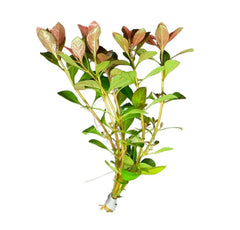
Ludwigia palustris: The absolute king of low-tech red plants. It stays relatively red even under modest lighting without supplemental gas.
-
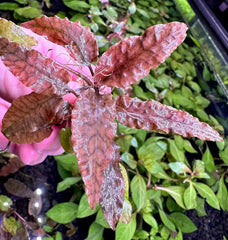
Cryptocoryne wendtii 'Bronze' or 'Red': A slow-growing, highly adaptable root feeder that thrives in low light and brings deep bronze tones without any high-tech gear.
-
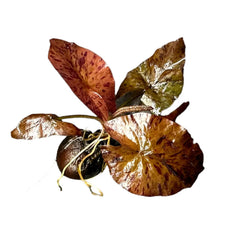
Tiger Lotus (Nymphaea zenkeri): A bulb plant that readily throws out large, wine-red lily pads with minimal effort under moderate light.
Medium Red Plants (Strong Light & CO2 Highly Recommended)
These plants will technically survive in a low-light, low-tech tank, but they will look dull maroon or olive-green, grow incredibly slowly, stretch out with long spaces between leaves, and suffer from frequent lower-leaf melting.
-
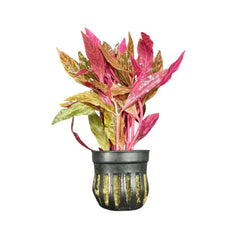
Alternanthera reineckii rosanervig: Known for its striking bright pink undersides, it struggles to stay dense and vibrant without a steady carbon source and decent light.
-
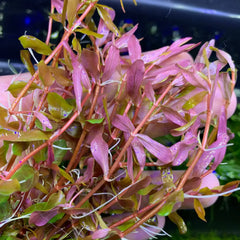
Rotala rotundifolia Hra: In low-tech or low-light tanks, this plant usually stays a dull yellowish-green, only showing orange tints at the absolute very top closest to the light source.
Advanced Red Plants (Strong Light & High CO2 Mandatory)
Without the combination of intense lighting and pressurized CO2 injection, these species cannot process nutrients fast enough to survive. They will stunt, drop their leaves, turn black, and rot away within a matter of weeks.
-
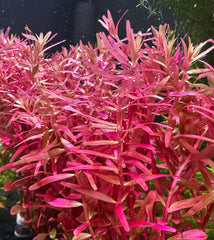
Rotala magenta: A notoriously finicky, delicate plant that demands high CO2, soft water, and intense light to display its iconic candy-red coloration.
-
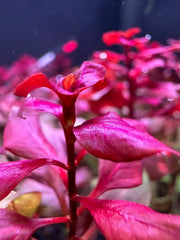
Ludwigia super red mini: A stunning, dark red stem plant that will instantly melt if carbon dioxide levels drop or if the lighting is even slightly dim.
The Low-Tech Secret to Red Tones: Nitrate Limitation
If you choose to run a low-tech aquarium without an injected pressurized system or high-end lighting, there is a biological loophole you can exploit to induce red coloration: Nitrate Limitation.
When certain stem plants (especially within the Rotala family) experience low levels of nitrogen in the water column while receiving adequate light and rich micronutrients, their chlorophyll production slows down. Because chlorophyll is rich in nitrogen, a lack of it forces the plant to expose its underlying carotenoid and anthocyanin pigments.
To successfully utilize nitrate limitation in a non-CO2 aquarium, you must:
-
Keep water column nitrates consistently low (around 5 ppm or fewer).
-
Ensure the plants get their primary macro-nutrition via a rich, fertilized root soil rather than liquid fertilizers.
-
Maintain a lean liquid dosing regimen emphasizing iron and trace minerals while keeping liquid nitrogen low.
Alternative Strategies for Red Plants Without Pressurized CO2 or Elite Lights
If you choose not to run an explicit pressurized cylinder setup or expensive high-PAR lights, you can still maximize your chances of success with specific hardy red varieties using these core strategies:
-
Optimize Light Spectrum, Not Just Intensity: Instead of blasting cheap, blinding white light (which just grows algae), use a high-quality LED light fixture that features dedicated red and blue diodes (often marketed as RGB lights). The red spectrum encourages anthocyanin production and makes the red pigments in the tank visually pop to the human eye, even at lower total intensities.
-
Heavy Root Feeding: In low-tech setups, ensure your red plants are planted in an active aquarium soil (aquasoil) rather than inert gravel or sand. Supplement the root zones with specialized root tabs packed with iron and potassium, which support strong tissue development without polluting the water column.
-
Utilize Liquid Carbon Substitutes: While products labeled as "liquid carbon" (like glutaraldehyde) do not actually provide true gaseous carbon dioxide for macro-synthesis, they act as mild photosynthetic intermediaries and effective algaecides. Daily dosing helps keep leaves free of biological films, maximizing the amount of light energy the plant can absorb.
The Verdict: Is the Combination Essential?
Ultimately, while you can achieve beautiful bronze, orange, and deep brown shades in a low-tech tank by selecting hardy species and managing nutrients carefully, true, electric crimson and candy-pink coloration requires both strong lighting and pressurized CO2 injection. Think of strong lighting as the accelerator pedal that tells the plant to turn red, and injected CO2 as the high-octane fuel that allows the engine to handle that speed without crashing. Together, they transform the aquascaping ecosystem, providing the biological margin of error needed to accelerate plant metabolism, outcompete nuisance algae, and unlock those breathtaking, vibrant hues.
Freshwater Aquarium Care Guides
Shop related: Red Plants, All plants, WeekAqua Lighting, Fertilizers, Water Test Strips.
Other blogs: How many hours of light do aquarium plants really need, Why are my plants losing leaves, Choosing the best aquarium substrate, Increasing red coloration in aquarium plants.