

When setting up a dense planted aquarium, hobbyists often invest heavily in high-output LED lighting, pressurized CO2 systems, and nutrient-rich substrates. However, one of the most critical yet frequently overlooked factors determining the success or failure of a high-tech aquascape is water flow. Maintaining proper circulation is just one piece of the puzzle, and mastering it works hand-in-hand with the foundational principles found in our comprehensive freshwater aquarium care guides.
In a densely planted environment, proper circulation does far more than just move water—it acts as the primary delivery system for nutrients, regulates gas exchange, prevents nuisance algae, and ensures uniform growth across all plant zones.
Why Dense Planted Tanks Have Unique Flow Dynamics
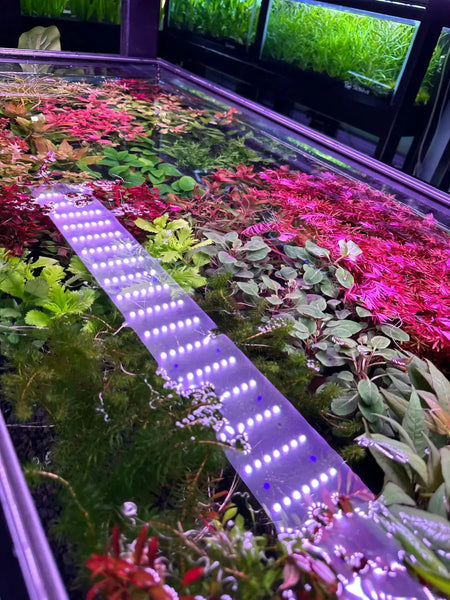
As aquatic plants grow and form dense thickets—especially stem species like Rotala, Ludwigia, or dense carpet plants like Monte Carlo—they create physical barriers to water movement.
-
The Barrier Effect: Dense foliage slows down current dramatically, creating friction and converting high-velocity flow into stagnant micro-environments.
-
Dead Zones: Areas behind large driftwood, rock hardscapes, or within thick stem bush clusters often receive zero water movement, leading to localized nutrient starvation.
-
Biomass Resistance: As plant biomass increases over time, the total flow required to penetrate the tank increases proportionally.
The Core Benefits of Adequate Water Flow
1. Efficient CO2 and Nutrient Delivery
Aquatic plants consume dissolved carbon dioxide (CO2), macronutrients (Nitrogen, Phosphorus, Potassium), and micronutrients through their leaves.
-
Boundary Layer Reduction: Leaves are surrounded by a stagnant layer of water known as the boundary layer. Strong, steady flow thins this layer, allowing CO2 and nutrients to diffuse into the plant tissue much faster.
-
Preventing Localized Depletion: Without adequate flow, a dense cluster of plants will quickly consume all available CO2 in its immediate vicinity, causing leaf melting or stunted growth even if the main tank indicator shows optimal gas levels.
2. Algae Prevention and Waste Removal
Algae thrives in stagnant, organic-rich environments. Proper circulation is your best non-chemical defense against algae blooms.
-
Detritus Suspension: Good flow keeps organic waste, excess fish food, and decaying plant matter suspended in the water column so the mechanical filter can remove it.
-
Dispersal of Organic Waste: Stagnant zones accumulate organic detritus, which breaks down into localized ammonium spikes—the primary trigger for Black Brush Algae (BBA) and Staghorn Algae.
3. Surface Agitation and Gas Exchange
While excessive surface movement can drive off dissolved CO2, a gentle, continuous surface ripple is essential.
-
Oxygenation: Ensures high dissolved oxygen levels for livestock and beneficial nitrifying bacteria, especially at night when plants switch from photosynthesis to respiration.
-
Biofilm Elimination: Surface circulation breaks up organic surface scum (protein film), improving light penetration and gas exchange.
Determining the Ideal Flow Rate
A general rule of thumb for standard aquariums is a turnover rate of 4× to 5× the tank volume per hour. However, dense planted tanks require a higher turnover rate of 8× to 10× tank volume per hour.
-
Low-Tech or Lightly Planted: Requires 3× to 5× turnover per hour (approx. 300 to 500 liters/hour for a 100L tank).
-
Medium Density Planted: Requires 5× to 8× turnover per hour (approx. 500 to 800 liters/hour for a 100L tank).
-
High-Tech Dense Planted: Requires 8× to 10×+ turnover per hour (approx. 800 to 1000+ liters/hour for a 100L tank).
Note: Filter flow ratings drop significantly once filter media, inline heaters, and CO2 reactors are attached. Always factor in a 30% to 50% real-world drop from manufacturer claims.
Optimizing Circulation Patterns and Outflow Types
It is not just about the volume of water moved, but how it moves through the layout.
[ Outflow / Lily Pipe ]  ===============>  [ Front Glass ]
        |                                         |
        v                                         v
  (Drives Down)                             (Deflects Down)
        |                                         |
        <=============== [ Substrate Level ] <=====
Circulation Strategies
-
The Circular Loop Pattern: Position the outflow along the side wall near the back, pointing straight toward the front glass. The water hits the front pane, travels down toward the substrate, moves across the carpet plants, and returns along the back wall to the intake.
-
Pulsed Wavemaker Flow: In ultra-dense or extra-long tanks, adding a small circulation pump or wavemaker set to a gentle pulse helps push water through thick stem clusters without uprooting delicate plants.
Choosing Outflow Hardware
-
Standard Lily Pipes: Create a gentle, directional stream with modest surface agitation—ideal for standard high-tech layouts.
-
Poppy Pipes: Direct water upward, reducing velocity; ideal for shallow tanks or nano setups with delicate fish.
-
Jet / Spin Pipes: Useful for localized circulation adjustments or smaller cubes where swirling movement is preferred over a direct jet.
Troubleshooting Common Water Flow Issues
-
Leaves swaying gently: The gold standard for optimal flow. If leaves are motionless, flow is too weak; if stems are bent permanently at 45 degrees, flow is too aggressive.
-
BBA appearing on hardscape: Indicates a high-flow area with excess dissolved organics or fluctuating CO2 levels. Adjust flow direction or clean your filter lines.
-
Melting lower leaves on stems: Often a sign that flow and light are failing to penetrate the dense upper canopy, leading to localized nutrient starvation.
Freshwater Aquarium Care Guides
Shop Related: Aquarium Plants, Lighting, Co2 Equipment, Fertilizers.
Other Blogs: Do red plants really need injected co2 and strong lighting, Top 5 best floating plants to lower nitrates, How to use aquarium glue to secure epiphytes to hardscape, The ultimate guide to increase red coloration in plants.