

Setting up a new fish tank brings up one crucial question that every hobbyist faces: How deep should your aquarium substrate be?
Getting the depth of your gravel, sand, or aqua soil right is about more than just aesthetics. Substrate depth directly impacts your aquarium's biological filtration, the root health of your live plants, and whether or not toxic gas pockets form in your tank.
If you are currently mapping out your entire tank configuration, reviewing a complete freshwater aquarium setup guide can ensure you get every element right from day one. As a general rule of thumb, the ideal aquarium substrate depth is 2 to 3 inches (5 to 7.5 cm). However, the perfect depth for your specific tank depends heavily on whether you are keeping a fish-only setup, a heavily planted aquascape, or specialized bottom-dwelling livestock.
Why Substrate Depth Matters
Before buying bags of substrate, it helps to understand why the bed thickness matters to your closed aquatic ecosystem:
-
Biological Filtration: Substrate acts as a massive home for beneficial nitrifying bacteria. If it is too shallow, you lose out on valuable surface area for bio-filtration.
-
Plant Root Anchoring: Heavy root-feeding plants require a deep bed to anchor themselves and absorb nutrients.
-
Preventing Toxic Gas Pockets: If sand or fine substrate is piled too deep without proper maintenance, anaerobic zones (oxygen-depleted areas) can develop. These zones can produce toxic hydrogen sulfide gas, which smells like rotten eggs and can harm fish if suddenly released.
Recommended Substrate Depths by Tank Type
Different aquarium setups require vastly different substrate strategies. Use this breakdown to find the target depth for your tank.
Fish-Only Aquariums (1 to 2 Inches)
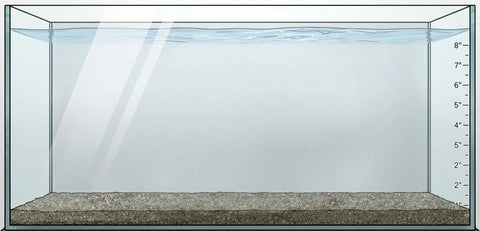
If you are not growing live plants with root systems, you do not need a deep bed. 1 to 2 inches (2.5 to 5 cm) is perfect. This provides enough coverage to look visually appealing and host beneficial bacteria, but stays shallow enough that a standard siphon gravel vacuum can easily pull out fish waste (detritus) during water changes.
Planted Aquariums (2 to 3+ Inches)
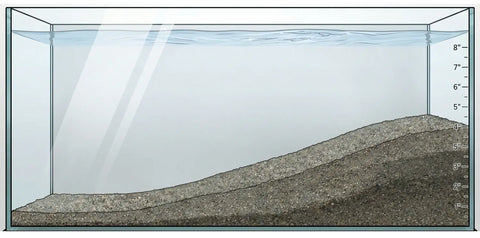
Live aquatic plants change the rules completely. They require vertical space to branch out their roots and pull nutrients from root tabs or active aqua soil. A depth of 2 to 3 inches (5 to 7.5 cm) is the minimum. For large tanks with heavy root-feeding plants, a depth of 3 to 4 inches in the background is common, sometimes even more.
Expert aquascapers often slope the substrate—keeping it 2 inches deep at the front of the glass for clean visuals, and sloping it up to 4-5 inches deep toward the back to give tall background plants plenty of rooting room.
Specialized Tanks for Burrowing Fish & Shrimp (2 to 3 Inches)
Certain livestock have unique behavioral needs that demand specific substrate depths. For these tanks, 2 to 3 inches (5 to 7.5 cm) of soft sand is ideal.
Species like Corydoras catfish, Kuhli loaches, and Geophagus cichlids naturally sift through sand looking for food. If the bed is too shallow, they will constantly scrape themselves on the bare glass bottom. Burrowing species like Freshwater Clams or Assassin Snails also need a minimum of 2 inches to submerge themselves completely.
Substrate Type vs. Depth Safety
The material you choose changes how deep you can safely pile it.
Fine Sand Substrates
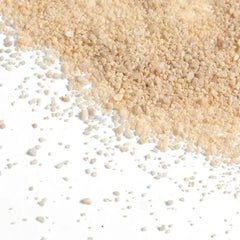
Sand packs down tightly over time. Because water cannot easily circulate between the tiny grains, oxygen drops off quickly below the surface. Avoid letting sand beds exceed 2.5 to 3 inches unless you have burrowing animals (like Malaysian Trumpet Snails) that constantly stir up the sand and keep it oxygenated.
Coarse Gravel Substrates
Gravel has large gaps between the stones, allowing water and dissolved oxygen to flow more freely into the deeper layers. Because of this high water circulation, you can safely stack gravel up to 3 to 4 inches without major risks of toxic anaerobic pockets forming. However, keep in mind that fish waste will slip deep into those gaps, requiring thorough gravel vacuuming.
How to Calculate How Much Substrate You Need
Instead of guessing how many bags to buy at the pet store, you can use a simple mathematical formula to figure out exactly how many pounds of substrate you need to hit your target depth.
For standard gravel or sand, use this calculation:
For example, if you have a standard 20-gallon long tank that is 30 inches long and 12 inches wide, and you want a desired depth of 2 inches, the math looks like this:
Keep in mind that this formula applies to standard dense gravel and sand. Lightweight porous clays or manufactured active aqua soils will require significantly less weight to fill the exact same volume.
Freshwater Aquarium Care Guides
Shop related: Live Plants, Aquarium Sand, Plant Substrate, Aquavitro Aquasolum, Water Care.
Other blogs: How Does Spectrum Affect Plant Balance More Than Brightness, Why Snails Are Essential For a Self-Sustained Ecosystem, What Makes Mystery Snails Ideal for Beginner Tanks, Aquarium Green Water - Causes And How To Improve.