

The Ultimate Diagnostic Guide: Top 5 Aquarium Plant Deficiencies in a Freshwater Aquarium
Maintaining a lush, vibrant planted aquarium is one of the most rewarding achievements in the fishkeeping hobby. When your aquatic plants thrive, they act as a powerful natural filtration system—absorbing heavy metals, processing fish waste, and oxygenating the water column while actively preventing nuisance algae blooms.
Whether you're starting from scratch with our freshwater aquarium setup guide or trying to optimize an existing scape, keeping your greenery healthy comes down to mastering nutrient balance. When plants lack essential resources, they cannot hide it. They begin to pale, stunt, holes appear, or they melt away entirely. This guide will help you decode exactly what your plants are trying to tell you by breaking down the top 5 most common aquarium plant deficiencies, the science of how nutrients move, and how to fix them permanently.
The Master Key to Diagnosis: Mobile vs Immobile Nutrients
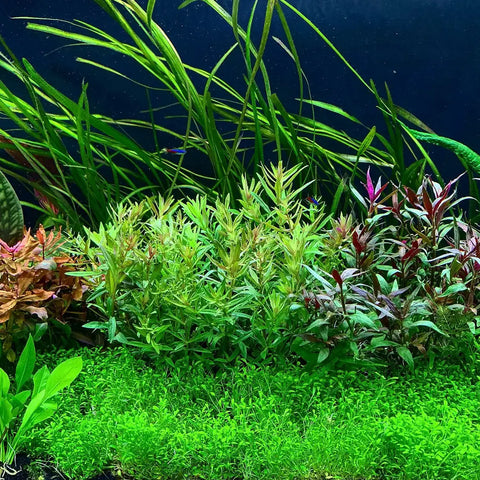
Before jumping into individual nutrients, you must understand a fundamental rule of plant biology. When a nutrient shortage occurs, the location of the first symptoms tells you almost everything you need to know. Nutrients are categorized into two groups:
1. Mobile Nutrients
These are elements that a plant can freely transport across its internal cellular network. If these elements become scarce in the water column, the plant will automatically "cannibalize" them from its oldest, lowest leaves and reroute them to save the new growth at the top.
-
Where symptoms start: Oldest, lowest leaves.
-
Primary Examples: Nitrogen (N), Phosphorus (P), Potassium (K), Magnesium (Mg).
2. Immobile Nutrients
These are structural elements that become permanently locked into the plant’s tissue once they are integrated. If the water column runs dry of these nutrients, the plant cannot steal them from older leaves to feed the top.
-
Where symptoms start: Newest growth, tips, and emerging leaves.
-
Primary Examples: Iron (Fe), Calcium (Ca), Sulfur (S).
Top 5 Most Common Aquarium Plant Deficiencies
1. Iron (Fe) Deficiency
-
Nutrient Type: Immobile
-
Primary Target: High-tech stem plants, red plants, and fast growers.
The Science Behind It
Iron is the master catalyst for chlorophyll synthesis. Even though it is considered a micronutrient (trace element), plants require a constant, stable supply of it to manufacture the green pigments necessary to capture light energy.
Visual Symptoms
Because Iron is immobile, the older leaves will remain completely green, while the brand-new leaves at the absolute tips of the stems emerge pale yellow or bleached white. This is known as interveinal chlorosis. In extreme cases, the new leaves look like translucent ghosts, lacking any structural integrity, and will quickly crisp or melt away.
How to Fix It
-
Check Your pH First: Standard iron supplements (EDTA Iron) break down and become useless to plants if your aquarium water’s pH is above 6.5. If you have alkaline water, switch to DTPA or EDDHA chelated iron, which remains stable at higher pH levels.
-
Target Dosing: Add a concentrated liquid iron supplement directly to the water column, or insert iron-rich root tabs into the substrate near heavy root-feeders like Amazon Swords.
2. Potassium (K) Deficiency
-
Nutrient Type: Mobile
-
Primary Target: Broad-leafed plants like Java Ferns, Anubias, and large stem plants.
The Science Behind It
Potassium regulates a plant’s enzyme activation, osmotic fluid pressure, and the internal transport of sugars. Unlike nitrogen and phosphorus, which accumulate naturally through fish food and waste, potassium is rarely introduced to an aquarium through natural means. It must almost always be manually dosed.
Visual Symptoms
Because it is mobile, the plant pulls potassium from the base leaves. Look closely at your oldest leaves for tiny, distinct black or brown pinholes. Over time, the tissue around these pinholes will turn yellow and decay, causing the holes to expand until the older leaf looks completely skeletal and drops off, while the new growth at the top continues to look perfectly normal.
How to Fix It
-
Dose Potassium Sulfate (K2SO4): Most commercial All-in-One fertilizers contain potassium, but if you see active pinholes, you need to supplement additional Potassium safely.
-
Check Substrate: If you are using inert sand or gravel, your plants are entirely dependent on the water column; ensure you add comprehensive root tabs to give them a steady substrate supply.
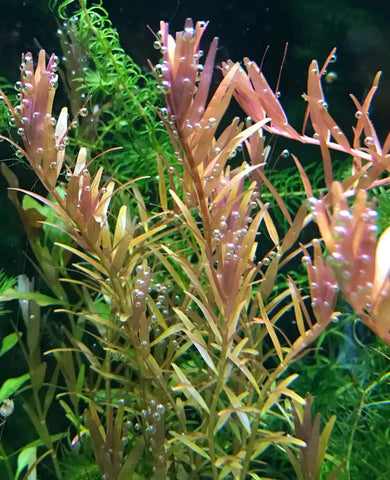
3. Nitrogen (N) Deficiency
-
Nutrient Type: Mobile
-
Primary Target: All aquatic plants, particularly fast-growing stem plants.
The Science Behind It
Nitrogen is an absolute essential macronutrient. It is a fundamental component of amino acids, proteins, and the actual structure of chlorophyll. While fish waste (ammonia and nitrates) supplies a baseline level of nitrogen, heavily planted tanks or setups with high lighting will rapidly outpace what a normal fish load can provide.
Visual Symptoms
The entire plant's growth will grind to a halt. On a granular level, you will witness a slow, uniform yellowing of the oldest leaves at the bottom of the plant. Unlike an iron deficiency, the yellowing is completely even—the veins do not stay green. Eventually, these lower leaves translucent-out, turn brown, dissolve, and shed into the water column.
How to Fix It
-
Test Your Nitrates (NO3): Use a reliable liquid test kit. In a dedicated planted aquarium, your target nitrate levels should read between 10 to 20 ppm. If your test reads 0 ppm, your plants are literally starving.
-
Supplement Macro Fertilizers: Safely lift your nitrogen levels by dosing a fertilizer containing Potassium Nitrate (KNO3).
4. Phosphorus (P) Deficiency
-
Nutrient Type: Mobile
-
Primary Target: Slow-growing epiphytes (Anubias, Bucephalandra) and carpet plants.
The Science Behind It
Phosphorus is critical for energy transfer within plant cells (via ATP molecules) and acts as the structural foundation for DNA and cell membranes. It is vital for healthy root development and triggering new shoots.
Visual Symptoms
Phosphorus deficiency presents a unique paradox. Instead of turning yellow, the oldest leaves will turn an unnaturally dark, dull, matte green, sometimes even developing a subtle purple or deep blue tint. Growth completely stalls, and because the plant is struggling and leaking sugars, these weakened old leaves will quickly become caked in a stubborn layer of Green Spot Algae (GSA).
How to Fix It
-
Maintain the 10:1 Redfield Ratio: In aquarium chemistry, you want to maintain roughly 10 parts Nitrogen to 1 part Phosphorus. If your Nitrates are at 10 ppm, aim to dose your Phosphates (PO4) to 1.0 ppm.
-
Add Monopotassium Phosphate (KH2PO4): Safely raising your phosphate levels will quickly stop the progression of the dark leaves and dramatically reduce Green Spot Algae outbreaks.
5. Carbon Dioxide (CO2) Deficiency
-
Nutrient Type: Foundational Carbon Source
-
Primary Target: Any aquarium using medium-to-high intensity LED lighting.
The Science Behind It
While carbon is technically a gas and not a solid fertilizer mineral, it is the absolute single most important nutrient a plant requires. Carbon makes up roughly 45% of a plant's dry mass. When you turn up the intensity of your aquarium lights, you accelerate the plant's metabolism. If there is not enough dissolved carbon dioxide in the water to match that speed, the plant’s internal engine breaks down.
Visual Symptoms
A CO2 bottleneck manifests as an identity crisis of multiple deficiencies at once. Plants will exhibit stunted growth, twisted or curled new leaves, and widespread melting from the bottom stems up. Crucially, a carbon deficiency is almost always accompanied by a massive explosion of opportunistic algae, specifically Black Beard Algae (BBA) and Staghorn Algae, which thrive in environments with high light and fluctuating or low carbon levels.
How to Fix It
-
Calibrate Your Drop Checker: If you inject pressurized CO2, make sure your fluid drop checker is a consistent, bright lime green during the photoperiod. If it is dark blue or deep green, your plants don't have enough carbon.
-
Improve Internal Flow: Sometimes you are injecting enough gas, but it isn't reaching the plants. Ensure your filter outlets or wavemakers eliminate "dead zones" so that nutrient-rich water actively rushes through every plant cluster.
The Law of the Minimum
When troubleshooting your aquarium, always remember Liebig's Law of the Minimum. If you have perfect lighting, perfect nitrogen, and perfect potassium, but your iron is at zero, your plants will stop growing and display an iron deficiency.
Approach your tank like an ecosystem: adjust one variable at a time, watch how the new growth responds over the course of two weeks, and gradually guide your aquarium back into perfect biochemical balance.
Freshwater Aquarium Care Guides
Shop related: Aquatic Plants, Nutrient Starter Pack, All Aquatic Plant Fertilizer, Nutrient Rich Aquasoil.
Other blogs: Why are my aquatic plants losing leaves, How many hours of light do plants need, Top 5 floating plants that lower nitrates fast.