

When setting up a thriving planted tank, few equipment choices spark as much discussion as lighting. Among parameters like wattage, lumens, and Photosynthetically Active Radiation (PAR), the Kelvin (K) rating remains a cornerstone metric printed on every aquarium LED fixture box.
Color temperature shapes the overall mood of your aquascape. It controls whether your aquatic environment looks like a warm, sun-drenched Amazonian stream or a crisp, mountain spring. Beyond visual aesthetics, Kelvin rating serves as an indicator of light wavelength distribution—a fundamental factor driving plant photosynthesis, stem elongation, and leaf coloration.
In this guide, we unpack what Kelvin rating means for planted aquariums, how color temperature interacts with plant biology, and how to choose the ideal light spectrum for your specific aquascaping layout.
What Is Kelvin Rating in Aquarium Lighting?
In physics, Kelvin is an absolute unit of temperature. When applied to lighting, color temperature describes the visual color appearance emitted by a theoretical "blackbody radiator" heated to extreme temperatures.
As an object heats up, it glows red, then yellow, neutral white, bright daylight white, and finally blue:
-
1000K to 3000K (Warm / Amber Spectrum): Emits a soft, reddish-yellow hue similar to candlelight or sunrise.
-
4000K to 5000K (Neutral White): Delivers a balanced, warm-toned light comparable to late afternoon sunlight.
-
6500K to 7500K (Natural Daylight Spectrum): Replicates noon sunlight under open skies. This is widely considered the golden standard baseline for freshwater aquascapes.
-
8000K to 10000K (Cool White / Ice Blue): Produces a crisp, blue-white light that offers high clarity and deep water penetration.
-
12000K to 20000K (Actinic / Marine Blue): Dominated by intense blue wavelengths, ideal for deep saltwater reef tanks but generally unsuitable for planted freshwater setups.
For general scientific information on color temperature, you can consult authoritative photobiology guides such as the National Center for Biotechnology Information (NCBI) or light measurement standards provided by the Illuminating Engineering Society (IES).
Kelvin Rating vs. Light Spectrum: Understanding the Difference
A common misconception among beginner aquascapers is that Kelvin rating dictates plant growth directly. In reality, Kelvin measures how light appears to the human eye, whereas plants respond to specific light wavelengths (nanometers) within the PAR spectrum (400–700 nm).
Two light fixtures with an identical 6500K rating can have drastically different spectral outputs:
-
Fluorescent or Single-Chip White LEDs: Achieve 6500K by combining broad yellow phosphors with a sharp blue peak.
-
Modern WRGB (White, Red, Green, Blue) LEDs: Achieve 6500K by mixing distinct narrow peaks across red, green, and blue diodes.
While both lights appear neutral white to human perception, the WRGB fixture delivers concentrated red wavelengths that trigger deep crimson pigments in aquatic plants like Ludwigia repens or Ammania gracilis.
To understand how Kelvin correlates with spectral bias across common aquarium lighting choices, review the chart below:
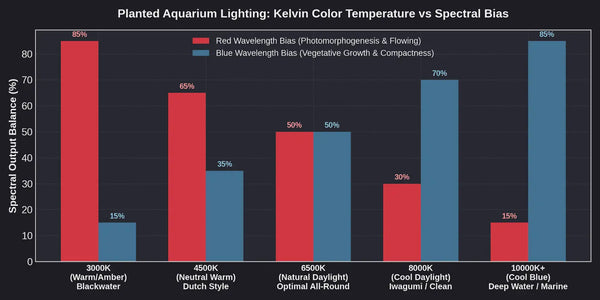
As demonstrated in the graph, lower Kelvin fixtures lean heavily into the red spectrum, whereas higher Kelvin fixtures tilt toward blue wavelengths. Achieving a balanced 6500K output provides a equilibrium that satisfies both biological needs and aesthetic color representation.
How Aquatic Plants Use Color Spectrum for Growth
Aquatic plants perform photosynthesis primarily using two photoreceptor pigments: Chlorophyll A and Chlorophyll B. According to botanical research available through academic platforms like ScienceDirect, these pigments absorb light energy most efficiently at specific peak wavelengths:
The Blue Wavelength Peak (430 nm – 460 nm)
Blue light penetrates deep water columns effectively. Plants utilize blue light for photomorphogenesis—the physiological process regulating leaf expansion, root orientation, and compact stem node spacing. Without sufficient blue light, stem plants tend to grow "leggy," stretching upward with long, sparse distances between leaf nodes.
The Red Wavelength Peak (640 nm – 680 nm)
Red light drives the heaviest engine of photosynthesis and mass accumulation. Red wavelengths signal to the plant that light is abundant, encouraging broad leaf production and vigorous shoot branching. Furthermore, intense red light paired with proper fertilization stimulates anthocyanin production, causing red plants to display vivid scarlet and burgundy shades.
The Role of Green Light (500 nm – 560 nm)
Although green light was historically considered less critical because plants reflect much of it, modern plant biology shows that green light penetrates deep into dense plant canopies where red and blue light are filtered out. Additionally, green light is vital for human viewing, rendering aquatic greenery crisp and vibrant rather than murky.
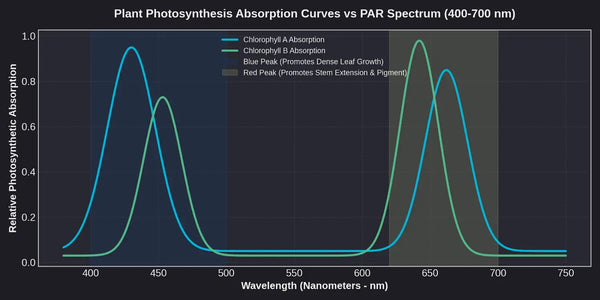
As highlighted in the absorption graph above, chlorophyll pigments feature twin absorption peaks in the blue and red bands. Light fixtures calibrated near 6500K align directly with these dual absorption peaks.
Breaking Down Kelvin Ranges for Different Aquascaping Styles
Choosing the right Kelvin rating depends on your plant selection, hardscape materials, and target aesthetic:
3000K – 4500K: Warm Amber & Blackwater Biotopes
-
Visual Profile: Warm, golden-yellow hue that mimics tannin-stained Amazon basin streams.
-
Best Used For: Blackwater aquariums with leaf litter, driftwood-heavy biotopes, and shade-tolerant species such as Anubias, Cryptocoryne, and Java Fern.
-
Drawbacks: Can make clear water look yellowish or murky and may overemphasize red algae if overall nutrient levels are unbalanced.
5500K – 7000K: Natural Daylight (The Universal Choice)
-
Visual Profile: Clean, neutral daylight that renders greens true to life and keeps reds balanced.
-
Best Used For: All general planted aquariums, Dutch-style layouts, and beginner setups.
-
Benefits: Delivers the ideal balance of red and blue PAR wavelengths required for steady photosynthesis across carpet plants, stem plants, and epiphytes.
7500K – 10000K: Cool Daylight & Iwagumi Layouts
-
Visual Profile: Crisp, icy white with a faint blue undertone that enhances water clarity and depth perception.
-
Best Used For: Iwagumi stone layouts, minimalist layouts featuring Monte Carlo or Eleocharis carpets, and deep tanks exceeding 20 inches in height.
-
Benefits: Superior light penetration through thick water columns. The cool tone accentuates grey rock textures (like Seiryu stone) and creates a stark, clinical aesthetic.
The Importance of CRI (Color Rendering Index)
When evaluating color temperature, you must also consider the Color Rendering Index (CRI). CRI measures on a scale from 0 to 100 how accurately a light source reveals the true colors of objects compared to natural sunlight.
-
CRI Below 80: Colors appear flat, dull, or artificially tinted. Red plants may look brownish or faded.
-
CRI 90 or Higher: Colors pop naturally. Greens look vibrant, fish scales display iridescent sheen, and red foliage appears rich and intense.
When purchasing an LED fixture for a planted tank, look for fixtures specifying both a 6500K–8000K spectrum and a CRI of 90+ for optimal visual performance.
How Light Intensity and Photoperiod Interact with Kelvin
Having the correct Kelvin rating will not yield healthy plants if your light duration (photoperiod) or intensity (PAR) is out of balance:
-
Photoperiod Duration: Keep daily lighting between 6 to 8 hours. Leaving lights on longer—regardless of Kelvin rating—is the leading trigger for unwanted green water, brush algae, and hair algae.
-
CO2 and Nutrient Balance: High light intensity accelerates plant metabolism. If light intensity is high but CO2 or liquid fertilizers are lacking, algae will capitalize on the unabsorbed light energy.
-
Ramp-Up Cycles: Utilize dimmable LED controllers to simulate a 30-minute sunrise and sunset transition, reducing stress on aquatic life.
Frequently Asked Questions (FAQ)
Can I use a 10000K marine light on a planted freshwater tank?
Yes, plants can grow under 10000K lighting because blue wavelengths fuel photosynthesis effectively. However, 10000K light lacks strong red output, which can make green plants look sterile and cause red stem plants to fade toward yellow-green over time.
Does a lower Kelvin light cause more algae?
Kelvin rating alone does not cause algae. Algae outbreaks stem from excess intensity (high PAR), excessively long photoperiods, or macro/micronutrient imbalances. However, warm lights below 4000K can make early algae growth more visually noticeable.
Are adjustable WRGB LED lights better than fixed Kelvin white lights?
WRGB LED lights offer significantly greater versatility. They allow hobbyists to adjust individual red, green, and blue light channels. This lets you custom-tailor the Kelvin temperature to your liking while ensuring your plants receive high PAR in the vital red and blue spectrum bands.
Finding the Perfect Light for Your Scape
Understanding color temperature removes the guesswork from choosing aquarium lighting. For most freshwater planted aquariums, targeting a 6500K to 7500K full-spectrum light with a CRI above 90 ensures robust photosynthesis, compact growth, and breathtaking color reproduction.
Freshwater Aquarium Care Guides
Shop related: All WeekAqua lighting, Lighting Accessories, Aquatic Plants, Plant Fertilizers.
Other blogs: Why are my aquarium plants dying, Do red aquarium plants really need co2 and strong lighting, How many hours of light do aquarium plants really need, Top 5 best foreground plants for beginner, How to get rid of black beard algae, Is a Week Aqua Light a Long-Term Investment for Serious Aquascaping?, What Makes the Week Aqua L Series Unique Among Aquarium Lights?.