

There is nothing quite like the frustration of looking at your aquarium and seeing a hazy, milky, or green mist instead of crystal-clear water. A cloudy aquarium is one of the most common issues hobbyists face, and it often strikes when you least expect it - like right after setting up a brand-new tank or doing a routine water change.
Cloudy water is rarely a sign that you are a "bad fishkeeper." Instead, it is your aquarium’s way of sending a distress signal. It means your miniature ecosystem is experiencing an imbalance. To restore balance and ensure your system has the proper structural groundwork, our freshwater aquarium setup guide provides step-by-step instructions on foundational parameters and installation techniques.
To clear the mist, you first need to identify exactly what is causing the cloudiness. This comprehensive guide breaks down the three main types of cloudy aquarium water, how to fix them, and how to keep your tank pristine for the long haul.
Part 1: Diagnosing the Cause of Cloudy Water
Before you throw treatments or chemicals at your tank, look closely at the color and timing of the cloudiness. Cloudy water generally falls into three distinct categories: white/milky haze, green tint, or brown/yellow debris.
1. White or Milky Cloudy Water (The Bacterial Bloom)
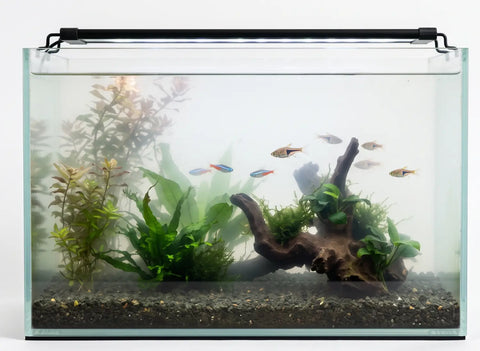
If your water looks like someone dropped a teaspoon of milk into it, you are likely dealing with a bacterial bloom.
When an aquarium has an excess of nutrients (organic waste, unconsumed fish food, decaying plant leaves) and not enough beneficial bacteria to process it, heterotrophic bacteria reproduce at an explosive rate. Millions of these microscopic organisms suspend themselves in the water column, creating a thick, milky haze.
This is incredibly common in two scenarios:
-
New Tank Syndrome: A freshly set up aquarium hasn't fully established its nitrogen cycle yet.
-
Post-Maintenance Cleanups: If you thoroughly scrubbed your filter media in tap water or replaced the filter cartridges completely, you may have accidentally wiped out your beneficial bacteria colony, triggering a mini-cycle.
2. Green Cloudy Water - The Algae Bloom
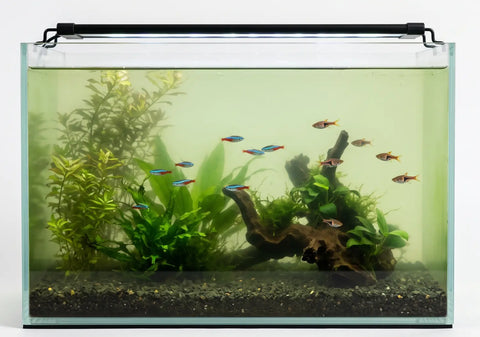
If the cloudiness has a distinct greenish hue, you are dealing with suspended green algae (often called an algae bloom or "green water").
Unlike algae that grows on your glass or rocks, this is a single-celled planktonic algae floating freely in the water. It is triggered by two main catalysts:
-
Excessive Light: The aquarium is getting too many hours of artificial light, or it is placed near a window receiving direct sunlight.
-
Nutrient Imbalances: High levels of phosphates and nitrates—often from overfeeding or over-fertilizing live plants—feed the algae.
3. Grey, Brown, or Dusty Cloudy Water (Mechanical Particles)
If the water looks dusty, or if tiny particles are swirling around, the cause is mechanical.
-
Unwashed Substrate: If this happens immediately after setting up a tank or adding new gravel/aqua soil, the substrate dust was likely suspended because it wasn't rinsed thoroughly beforehand.
-
Inadequate Filtration: Your filter may lack fine mechanical media to trap micro-debris, or the filter pump flow might be kicking up detritus from the bottom of the tank.
Part 2: How to Resolve Cloudy Aquarium Water
Once you know the culprit, you can apply the right solution. Here is how to fix each type of cloudiness step by step.
How to Fix a White/Milky Bacterial Bloom
Paradoxically, the best thing you can do for a standard bacterial bloom is nothing at all.
Large, panicked water changes often make a bacterial bloom worse. When you remove water and replace it with fresh, nutrient-rich tap water, you give the surviving bacteria a brand-new food source, causing the bloom to surge again.
-
Wait it Out: If it’s a new tank, let the cycle run. The bacteria will naturally starve themselves out and settle into the substrate and filter media within 4 to 7 days, and the water will clear up overnight.
-
Boost Surface Agitation: High populations of bacteria consume a massive amount of dissolved oxygen. Add an air stone or position your filter outlet to ripple the surface so your fish can breathe comfortably while the bloom subsides.
-
Add Beneficial Bacteria: Dose the tank with a high-quality liquid biological booster to help establish the autotrophic bacteria you actually want.
How to Fix Green Water
Planktonic algae is highly resilient and regular water changes will rarely fix it, as the algae reproduces faster than you can drain it.
-
Execute a Total Blackout: Algae relies entirely on light. Wrap your aquarium in a dark blanket or trash bags for 3 to 4 days. Turn off the aquarium lights completely and do not peek or feed your fish (your fish will be fine without food for a few days). Without light, the algae will collapse and die.
-
Install a UV Sterilizer: This is the ultimate "cheat code" for green water. A temporary inline or submersible UV sterilizer exposes the free-floating algae to ultraviolet light, destroying its DNA. Your water will go from pea-soup green to crystal clear in 24 to 48 hours.
How to Fix Mechanical Particle Cloudiness
If the cloudiness is just dust and floating debris, you need to upgrade your filter's ability to catch micro-particles.
-
Use Fine Filter Floss: Most standard filters come with coarse sponges. Add a layer of fine, dense filter floss (polyester batting) to your filter chamber. This acts as a fine sieve to catch microscopic dust. Throw the floss away once it turns brown and clogs up.
-
Apply a Water Clarifier (Flocculant): Safe chemical clarifiers work by binding microscopic dust particles together. It charges the floating dust so they clump into larger particles, making them heavy enough to sink or large enough to finally get trapped by your filter floss.
Part 3: How to Prevent Cloudy Water Permanently
An ounce of prevention is worth a pound of cure. To ensure your aquarium water stays beautifully clear moving forward, build these habits into your aquarium maintenance routine:
1. Master Your Feeding Habits
Overfeeding is the root cause of almost all bacterial and algae blooms. Unconsumed fish food breaks down into ammonia, phosphates, and nitrates. Feed your fish only what they can completely consume within two minutes, and actively remove any leftovers.
2. Practice Smart Filter Maintenance
Never wash your filter sponges, ceramic rings, or biological media under running tap water. The chlorine and chloramines in tap water will instantly kill your beneficial bacteria, triggering a milky bloom. Instead, always squeeze and rinse your filter media in a bucket of conditioned water siphoned out during your water change.
3. Control Your Lighting Schedule
To prevent green water from ever returning, put your aquarium lights on an automatic digital timer. Limit the photoperiod to 6 to 8 hours per day. Keep the aquarium entirely out of the path of ambient sunlight from nearby windows.
4. Rinse Substrates Thoroughly
Whenever you buy new gravel, sand, or specialized plant substrates, spend the extra time rinsing it in a bucket outside or in the shower until the water runs completely clear before placing it into the aquarium. When filling a tank with water for the first time, place a small plate or plastic bag over the substrate and pour the water directly onto the plate to avoid stirring up a dust storm.
5. Utilize Live Plants and Snails
A naturally balanced tank naturally resists cloudiness. Heavy-feeding live plants (like floating plants or fast-growing stem plants) actively absorb the excess nitrates and phosphates that would otherwise feed an algae bloom. Concurrently, adding helpful cleanup crew members like Nerite or Mystery snails ensures that leftover food and organic decay are eaten before they can fuel a massive bacterial bloom.
By understanding the science of what is happening behind the glass, you can stop treating cloudy water as a mystery and start addressing it with confidence. Keep your nutrients low, your biological filtration safe, and your lighting balanced, and you will enjoy a crystal-clear view of your underwater ecosystem day after day.
Freshwater Aquarium Care Guides
Shop related: Live Plants, Aquarium Snails, Fertilizers, Water Test Strips, Water Care.
Other blogs: Why are my aquarium plants dying? Top 5 mistakes, Do red aquarium plants really need co2, Best aquarium plants for bettas.