

Few plants have completely transformed the modern aquascaping landscape like Bucephalandra (known simply as "Buce" by hobbyists).
Once a highly guarded collector’s item traded in tiny pieces among elite hobbyists, Bucephalandra is now the crown jewel of high-end freshwater aquariums. With its metallic sheen, deep structural leaves, and an endless array of colors ranging from gunmetal gray to electric purple, it looks like a piece of living jewelry inside an aquascape.
However, because Buce is an exceptionally slow-growing, premium plant, mistakes can be devastatingly expensive. If you want your investment to thrive rather than turn into an expensive puddle of mush, you need a precise blueprint.
This advanced guide covers every technical aspect of Bucephalandra biology, water chemistry, structural placement, and troubleshooting.
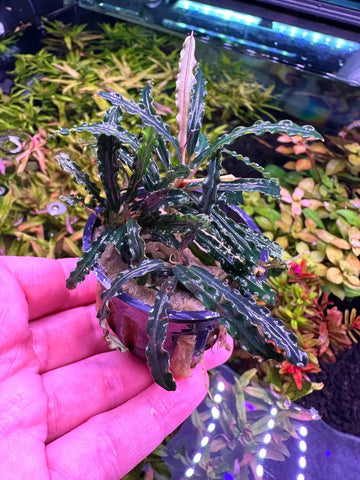
The Biological Anatomy of Bucephalandra
To keep this plant alive, you must understand how it grows. Bucephalandra belongs to the family Araceae (Aroids) and is an epiphyte, meaning it grows attached to hard surfaces rather than rooting into the ground.
The Rhizome: The Engine Room
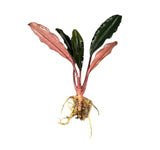
The most critical part of Buce anatomy is the rhizome—the thick, horizontal, modified stem that creeps along surfaces. The rhizome stores the plant's energy reserves, sends out anchor roots from its bottom side, and pushes out new leaf shoots from its tip.
Stomata and Reflective Crystals
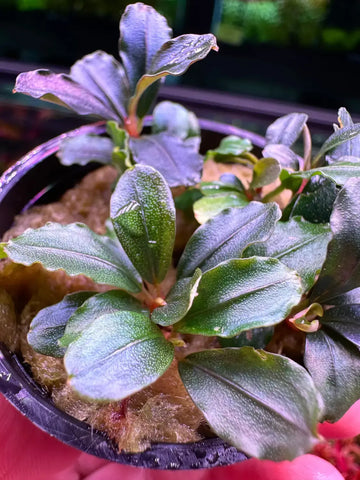
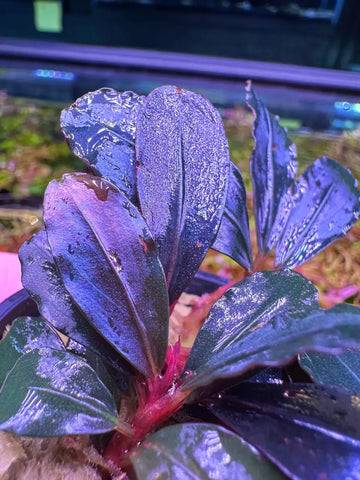
If you look closely at a healthy Buce leaf under good lighting, you will notice hundreds of tiny white or gold dots across the surface. These are not defects or pests; they are specialized cells and breathing pores (stomata).
Furthermore, Buce leaves possess a unique layer of microscopic crystalline structures that fracture light. This creates the signature metallic iridescence (shimmering blue, green, or violet hues) that makes the plant famous. It is an evolutionary adaptation designed to capture weak, dappled sunlight breaking through heavy tropical rainforest canopies.
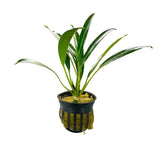
5 Non-Negotiable Rules for Growing Bucephalandra
While Buce is incredibly resilient once established, it will quickly fail if its baseline environmental rules are broken.
1. Zero Tolerance for Buried Rhizomes
The absolute golden rule of Bucephalandra care is that the rhizome must never be buried beneath substrate.
If you bury the rhizome in sand, gravel, or aquasoil, water flow and oxygen exchange cease entirely. This suffocates the plant tissue and invites anaerobic bacteria to take hold, resulting in swift, irreversible rhizome rot.
-
How to plant it right: Always anchor your Buce to rocks (lava rock is best due to its porous texture) or driftwood. You can wedge it into cracks, tie it down with line, or use a tiny smear of Cyanoacrylate-based superglue gel directly on the rhizome. The roots will naturally grip the hardscape within a few weeks.
2. Precise Water Chemistry and Temperature
Bucephalandra is native to pristine, highly oxygenated forest streams on the tropical island of Borneo. It requires clean, stable water conditions to truly thrive:
-
Temperature: 71°F to 78°F (21.5°C to 25.5°C). Avoid letting your tank sit above 80°F long-term; warm water holds less oxygen and significantly accelerates rhizome rot.
-
pH Range: 6.2 to 7.2 (Slightly acidic to neutral water mimics their natural rainforest run-off).
-
Water Hardness: Soft to medium-soft water is preferred. Aim for a General Hardness (gH) of 3 to 6, and a Carbonate Hardness (kH) of 1 to 4.
3. High Flow and High Oxygenation
In nature, Bucephalandra grows as a rheophyte—a plant structurally adapted to survive in rushing torrents and waterfalls. Because of this, it despises stagnant water.
Strong, consistent water movement across the leaves is essential. High flow carries away detritus and fish waste that would otherwise settle on the slow-growing leaves. If waste sits on a leaf, it blocks light penetration and instantly invites stubborn Black Beard Algae (BBA) or Green Spot Algae to choke out the plant.
4. Lighting: The Color Catalyst
Buce can survive perfectly well in low-light environments, making it a favorite for low-tech tanks. However, if kept under dim lights, almost every variety will default to a muted, dark green color.
To pull out the legendary reds, deep purples, and metallic blues, you must use medium-to-high, full-spectrum LED lighting. The intense light forces the plant to produce colorful protective pigments.
5. Carbon Dioxide (CO2) and Nutrient Balance
If you raise your lighting intensity to coax out colors without adding CO2, you will quickly end up with a tank full of algae.
Injecting CO2 gas (even a modest 15 to 20 parts per million) dramatically changes how Buce grows. It speeds up their agonizingly slow growth rate, helps them outcompete algae for resources, and yields significantly larger, cleaner, and more colorful leaves. Supplement this with a lean, steady routine of liquid macronutrients and micronutrients in the water column.
Wild Imports vs. Tissue Culture: What You Need to Know
When shopping for Bucephalandra, you will generally run into two distinct formats: Wild/Farm-Grown Imports or Lab-Grown Tissue Cultures.
Wild/Farm-Grown Rhizomes
These are typically sold as established clumps or single stems attached to small pieces of wire or volcanic rock.
-
Pros: They arrive with mature, full-sized leaf structures and immediate, stunning coloration.
-
Cons: They experience a more severe transition period when adapting to your water parameters.
Tissue Cultures (In-Vitro)
These are grown in sterile laboratory cups containing a nutrient-rich agar gel.
-
Pros: 100% sterile and guaranteed to be free of algae, snails, duckweed, and parasites. You get a massive number of tiny individual plantlets inside a single cup for a lower cost per plant.
-
Cons: The plantlets are incredibly small and delicate. They require careful handling, take much longer to grow into mature specimens, and are initially bright green, taking months to develop their true adult colors.
Diagnosing and Fixing "Buce Melt"
The most terrifying moment for any new Buce keeper is watching a prized plant drop all its leaves and dissolve into a transparent mush over the course of 48 hours. This is known as Buce Melt, and it is almost always caused by a sudden shift in environment.
Why it Happens
Bucephalandra is highly sensitive to changes in osmotic pressure (water parameters). If you move a plant from a low-tech tank to a high-tech tank, or if your water temperature swings rapidly during shipping, the plant panics. It sheds its existing leaves to preserve resources, planning to regrow a new set of leaves optimized for the new water chemistry.
The Survival Strategy
If your Buce begins to melt, do not throw it away!
-
Use a siphon or a soft brush to gently remove the dissolving leaves so they don't spike your ammonia levels.
-
Inspect the horizontal rhizome. If the rhizome is still firm, hard, and solid when you gently squeeze it, the plant is completely viable.
-
Leave it anchored in place, ensure your water parameters are stable, and within 2 to 4 weeks, you will see miniature, ultra-vibrant new leaves sprouting along the bare stem.
Step-by-Step Propagation
Because Bucephalandra naturally creeps horizontally, expanding your collection is incredibly simple once a clump takes off.
-
Step 1: Identify a healthy, mature clump with a long rhizome segment.
-
Step 2: Ensure the section you want to cut has at least 4 to 5 mature leaves and a few strong anchor roots trailing beneath it.
-
Step 3: Using a pair of sharp, curved aquascaping scissors or a sterilized razor blade, make a clean, swift slice right through the center of the rhizome. Avoid tearing or crushing the plant tissue.
-
Step 4: Take your new cutting, dry the bottom of the rhizome slightly with a paper towel, apply a pinpoint drop of superglue gel, and attach it to a new piece of rock or wood. The original mother plant will quickly push out two new growing tips from the location of the cut, resulting in a bushier look over time.
Ready to curate your own underwater jungle? We take pride in offering the highest-grade Bucephalandra on the market. From pristine, pest-free tissue cultures to premium, hand-selected imported clumps, we ensure every plant is packed with care and ready to make a statement in your tank.
Browse our exclusive Bucephalandra Collection today!
Freshwater Aquarium Care Guides
Shop related: All WeekAqua lighting, Lighting Accessories, Aquatic Plants, Plant Fertilizers.
Other blogs: Can aquarium plants grow in sand, Why do my aquarium plants have holes in them, Top 5 best foreground plants for beginner.