

Few topics in the fishkeeping world spark as much fierce debate as the humble water change. Ask five different hobbyists how often to change your aquarium water, and you will likely get five different answers ranging from “every single week” to “never, my tank is a self-sustaining ecosystem.”
If you are confused, you are not alone.
The truth is, there is no single "magic number" that applies to every tank. A high-tech, heavily planted aquascape has vastly different needs than a minimalist cichlid tank or a nano shrimp bowl. If you are looking to lighten your maintenance load naturally, our aquarium plants and cleanup crew guide covers how to build a balanced biological filtration system that keeps waste under control.
In this ultimate guide, we are breaking down the science, busting the biggest myths, and helping you calculate the exact water change schedule your specific aquarium needs to thrive.
The Core Science - Why Do We Change Aquarium Water?
To understand how often to change your water, you first need to understand why we do it. Filters are fantastic, but they do not magically destroy waste; they simply convert it.
In a cycled aquarium, the beneficial bacteria convert highly toxic ammonia (from fish waste and decaying food) into nitrites, and then into nitrates.
[Fish Waste / Decaying Matter] ➔ Ammonia (Highly Toxic) ➔ Nitrites (Toxic) ➔ Nitrates (Less Toxic)
While nitrates are significantly less harmful than ammonia or nitrites, they are still toxic in high concentrations. In nature, massive volumes of fresh water constantly dilute these waste products. In a closed glass box in your living room, evaporation only removes pure water, leaving the pollutants behind. Water changes serve two vital purposes:
-
Exporting Bad Elements: Diluting nitrates, phosphates, and dissolved organic compounds (DOCs) that trigger massive algae blooms and stress fish.
-
Importing Good Elements: Replenishing essential minerals, carbonates, and trace elements that plants and livestock absorb over time to maintain a stable pH.
The Baseline Rule of Thumb (And Why It Changes)
For a standard, moderately stocked aquarium, the golden baseline standard is:
10% to 25% water change every 1 to 2 weeks.
However, treating this rule as gospel can lead to trouble. Your ideal schedule depends entirely on your aquarium's unique ecosystem. Let's look at the factors that change the math.
1. The Nitrogen Bio-Load (The "Fish vs. Water" Ratio)
-
Heavy Bio-Load: If you love a heavily stocked tank, or keep "dirty" fish like Goldfish, Plecos, or large Cichlids, your nitrates will spike rapidly. You will likely need a 30% to 50% weekly water change.
-
Light Bio-Load: A 20-gallon tank housing only a handful of micro-rasboras or cherry shrimp produces very little waste. These setups can easily glide by on a 10% to 15% bi-weekly or monthly change.
2. The Aquascape & Plant Mass
Plants are nature’s ultimate filters. They actively consume nitrates and phosphates as fertilizer.
-
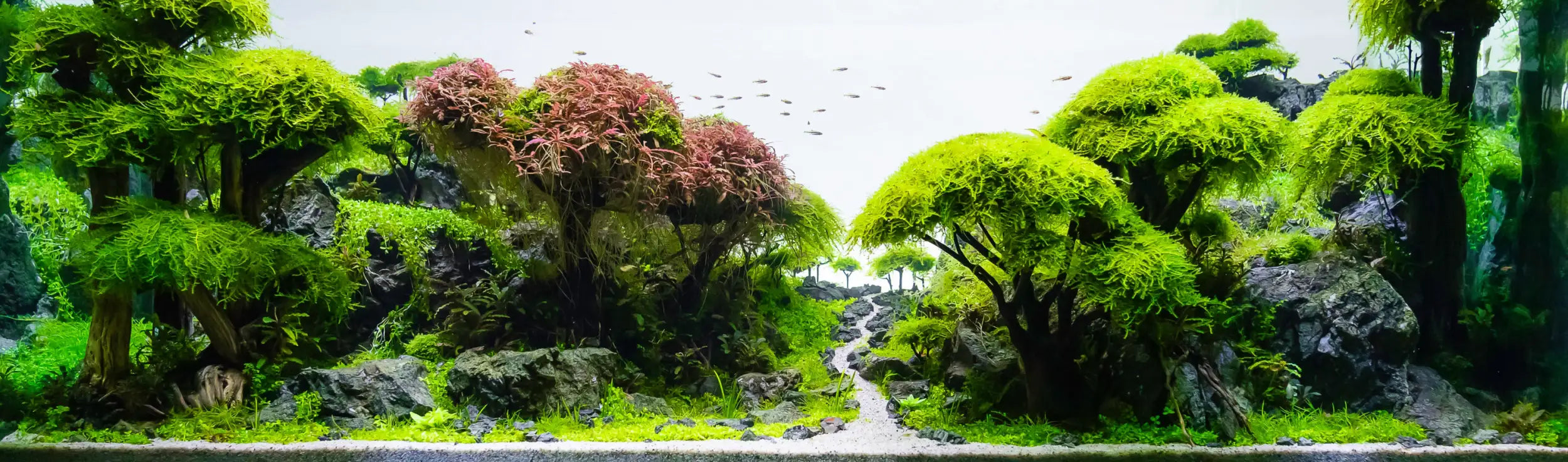
Heavily Planted (Low-Tech/High-Tech): In a jungle-style aquascape, the plants often consume nitrates faster than the fish can produce them. If your nitrates consistently read 0 ppm to 5 ppm, your water changes are less about removing waste and more about replenishing minerals. A 20% bi-weekly change is usually plenty.
-
Unplanted / Plastic Plant Tanks: Without live botanical help, nitrates accumulate unchecked. Regular weekly changes of 25% are mandatory to keep the environment safe.
How to Calculate Your Exact Water Change Schedule
Stop guessing and let the data tell you what to do. The single best tool in your arsenal is a high-quality liquid testing kit (like the API Freshwater Master Test Kit).
The Nitrate Test Method:
-
Test your water immediately before your usual water change day and write down the nitrate level.
-
Ideally, you want to keep your nitrates below 20 ppm (parts per million) for sensitive fish/shrimp, and below 40 ppm for hardier species.
-
If your test reads 40 ppm or higher before your scheduled day, your current routine isn't enough. You need to either increase the volume of the water change or perform them more frequently.
-
If your test consistently reads under 10 ppm week after week, you can safely extend the time between changes.
Why You Should Never Change 100% of the Water
A common beginner mistake is waiting until the water looks filthy, scooping the fish out, scrubbing the tank down, and replacing 100% of the water. Do not do this.
A 100% water change completely shocks the biology of your tank. Water parameters like pH, hardness (GH/KH), and temperature fluctuate wildly. This sudden environmental swing can throw your fish into osmotic shock, severely damaging their immune systems or causing sudden death.
Furthermore, you risk drying out or killing the beneficial bacteria colonies living on your substrate and filter media, effectively crashing your nitrogen cycle. Stick to a maximum of 50% at one time unless dealing with an extreme emergency (like a chemical contamination).
Step-by-Step: The Correct Way to Do a Water Change
To minimize stress on your livestock and keep your hands dry, follow this simple protocol:
-
Step 1: Prep Your New Water: Fill your buckets ahead of time. Use a high-quality water conditioner (like Seachem Prime) to instantly neutralize harmful chlorine and chloramines found in tap water.
-
Step 2: Match the Temperature: Use your hand or a digital thermometer to ensure the new water matches your aquarium’s temperature within 1–2 degrees. Pouring freezing or boiling water into a tank will trigger shock or ich outbreaks.
-
Step 3: Power Down: Turn off your heaters and filters. Heaters can crack if exposed to the open air while turned on, and filters shouldn't run dry.
-
Step 4: Siphon from the Bottom: Use a gravel vacuum to pull water from the bottom of the tank, targeting detritus trapped in the substrate or tucked behind hardscape rocks.
-
Step 5: Refill Gently: Slowly pour or pump the new, conditioned water back into the tank. Rest the stream on a piece of hardscape or a small plate to avoid kicking up your substrate and uprooting your beautiful plants.
-
Step 6: Power Up: Turn your equipment back on and verify everything is running smoothly.
Quick Reference Guide by Tank Type
To figure out where your aquarium fits, look at its specific setup and ecosystem requirements. A new or uncycled tank requires aggressive maintenance, needing a 15% to 20% water change every 2 to 3 days just to keep dangerous ammonia and nitrite spikes under control. A standard, moderately stocked community aquarium thrives on a stable routine of 25% every 1 to 2 weeks for general maintenance. However, if you have a heavily stocked tank with no live plants, you will need to push that to a weekly 30% to 50% change to actively reduce fast-rising nitrates.
On the flip side, specialized ecosystems allow for a lighter touch. A heavily planted aquascape typically only needs about 20% every 2 weeks, with a primary focus on replenishing minerals and keeping algae at bay rather than exporting heavy waste. Finally, delicate setups like shrimp and nano tanks require a conservative approach to avoid dangerous parameter swings; a light 10% to 15% change every 2 to 3 weeks is usually the sweet spot to keep your tiny inhabitants perfectly stable.
Final Thoughts: Consistency Over Perfection
When it comes to a beautiful aquarium, consistency is always better than drastic action. Performing a small, easy 15% water change every single week is infinitely better for your ecosystem than ignoring the tank for two months and performing a massive, stressful 70% overhaul.
Get to know your tank's bio-load, grab a test kit, and build a routine that works for your schedule and your lifestyle. Your fish—and your plants—will thank you for it!
Freshwater Aquarium Care Guides
Shop related: Beginner Plants, Water Care, Water Test Strips, Heaters, Aquarium Substrate, Cleaning Supplies.
Other Blogs: The Best Aquarium Plants for Bettas, Why Do Aquarium Plants Have Holes in Them, Why Are My Plants Loosing Leaves, Bucephalandra Care Guide, The Ultimate Guide to CO2 in Planted Tanks, Low-Tech vs High-Tech Aquascaping: Which One is Right For You.